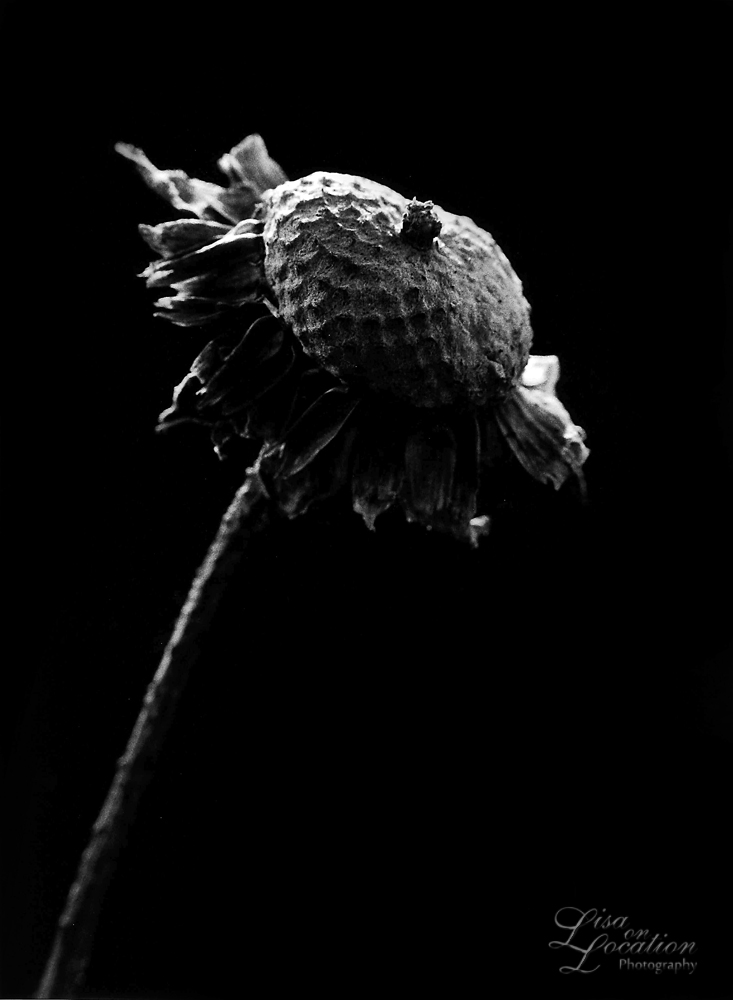
Lens: Canon 100mm 2.8 macro
Lisa On Location Now Playing: The Kinks The Kink Kontroversy
Chicken Ranch Central

Now Playing: Billy Idol Charmed LifeBlaschke by way of Blossfeldt Karl Blossfeldt (1865-1932), the German photographer who profoundly influenced macro as well as fine art photography in 1928 with his landmark volume, Art Forms in Nature, ironically didn't consider himself a photographer. Nor did he pursue photography as an art form. An enthusiastic amateur, to Blossfeld photography was merely a tool, a means to an end, and he used it as such. The fact that the images he so painstakingly created over a three-decade period were–and remain–jaw-droppingly beautiful is a happy coincidence, and one I am personally grateful for. As a photographer, I have many influences, many photographers of greater artistic vision and skill than my own who I greatly admire. Ansel Adams is one, of course, and Peter Lik is another obvious choice, as I deeply love breathtaking landscape photography. Less obvious are photographers such as Robert W. Wood, Simon Marsden, Elio Ciol and Martin Reeves (especially Reeves) who have done great work using the infrared portion of the spectrum. This appeals to my inclination to photograph that which can't be seen. I am drawn to the unusual, the obscure, the path less traveled. Blossfeldt appeals to this part of me–shooting what isn't visible–as his macro photography undeniably opened up a world normally invisible to the human eye in a way that proved both original and timeless. Blossfeldt possessed an innate artistic instinct, the ability to see elegance and beauty in nature where perhaps none before him had done so. Also possessing a nearly stereotypical German determination and dedication to efficiency, he could not merely create art for art's sake. There needed to be a greater purpose behind it, and for Blossfeldt, that purpose was education. The son of poor farming parents born just before German unification, Blossfeldt did not enjoy the privileged life of German aristocracy. At age 16 he left secondary school to apprentice in a metal work shop, creating decorative cast iron for architecture in distant Berlin. As a boy, he'd spend hours in the countryside studying nature, and his lifelong love of plants served him well in the metal shop. He relied on his keen observation of plant forms to inspire his designs, and his original patterns and forms soon created a demand for his work. His talent was apparent to everyone who came into contact with him, and mentors arranged for him to attend an art academy in Berlin. Blossfeldt's photographic career began around 1886, and true to form, it came about as an expression of pragmatism rather than artistry. One day, the art academy director visited Blossfeldt's drawing class and carefully examined a detailed sketch of a many-faceted dragonfly wing Blossfeldt had created. Instead of heaping praise on the young man, the director dismissed the details as "hocus pocus." Distressed by the director's refusal to believe the drawing was accurate and life-like, Blossfeldt stayed up all night creating a blown up photograph of the dragonfly wing to prove his point. This tenacious determination alone would be enough to make Blossfeldt my photographic hero, regardless of the quality of his photography. I strongly identify with this obsessive need to prove himself when dismissed by others, and have applied it to my photography as well as other endeavors in my life. I would not go so far as to claim we are kindred spirits–I do happen to enjoy creating photography for the sake of creation–but I do understand at least a tiny part of what makes him tick. In any event, this technique served him well in later years when he became an instructor at that same academy. As Blossfeldt had years before while apprenticing in the metal shop, the art academy relied on the forms of plants to instruct and inspire its students. To this end, the school maintained an extensive collection of dried specimens for reference. The collection took up a great deal of space, however, and proved very fragile and impractical to use. As an instructor, Blossfeldt hit upon the idea of using photographic references instead of the actual plants, and created a homemade plate camera with an extendable bellows that allowed magnification of subjects up to 45 times. He converted his office at the academy to a makeshift studio and dark room and devoted himself to photography in order to make himself the best teacher he could possibly be. Blossfeldt made macro images of plants he'd find on many excursions to the German countryside and beyond in his classes, examples he presented to architectural and design students, showing that all of the various styles and inventions of humanity had already been well-tested by nature. I intend to approach my subject matter in a similar fashion. I have dabbled in macro photography over the years, but never in a formal setting. I've never planned, never prepared for any macro shot until this course. I find myself emulating Blossfeldt in several ways on this project, first and foremost, developing a predatory eye for interesting plants and other subjects. Whereas Blossfeldt prowled the German countryside, I find myself slamming on the brakes whilst driving down a Texas farm road, because a stand of Texas thistles has just burst into bloom. Or parking in a no parking zone on the Texas State campus, because the perfect red yucca specimen three levels up in the planter caught my eye. Or combing through the thorny branches of huisache trees in order to find the perfect feathery blossom. I have carried home more dirty, twisty, spiny, thorny, bristly and bushy plant matter in the past month than I ever thought possible. And here's a secret: Once you start looking at the world this way, you can't turn it off. Even with my project complete and my prints finished and in the box, I still find myself collecting bits and pieces to save for future shoots. Despite the similarities in our methods of collecting subject matter, the conditions under which Blossfeldt and myself are taking our photographs are quite different. Blossfeldt worked in his academy studio using diffused natural light–sunlight either from above or directly in front–which necessitated extremely long exposures for the high magnifications and narrow apertures he photographed his subjects with. The slightest breeze would result in unacceptable blur in his images. Although other macro photographers of the time used artificial light, Blossfeldt did not. He eschewed impressionistic photographic techniques. His goal was not to impart any emotional quality to the subjects. Instead, he preferred stark, even clinical representations of his subjects to isolate the forms. First and foremost, Blossfeldt considered his images as teaching aids. I, on the other hand, am benefitting from the convenience of modern technology. While my studio setup is pitifully makeshift compared to Blossfeldt's, it did serve my purpose and give me the ability to leverage my available equipment to its maximum potential. The "studio" consisted of two pieces of left over foam core, one wrapped in foil to serve as a reflector and the other with a sheet of black felt tacked to it to serve as a background. I used a kneaded eraser to support larger, upright subjects, and used four-inch head pins with a dab of rubber cement to support smaller subjects suspended against the backdrop. Primary photography was accomplished with a Canon Elan 7ne 35mm camera, with test shots completed with a Canon 7D digital SLR. A Canon 100mm 2.8 macro lens was used exclusively, occasionally coupled with a Vivitar 2x telextender. Unlike Blossfeldt, I had no aversion to artificial lighting, using a Canon 580EX II speedlite on perhaps 90 percent of my photos. Off-camera lighting was aided by Cybersync radio triggers. In the end, I have created a portfolio of macro work that is both formal and aesthetic. Despite the influence of Blossfeldt and obvious visual cues, my work is distinctly separate from his. In fact, out of the dozens of prints I made in the darkroom (and the hundreds more shots I took that I never developed) a grand total of one vaguely resembled the imaging and print style of Blossfeldt, and I stumbled across that quite accidentally rather than by intent. And, to my knowledge, other than that initial dragonfly photograph Blossfeldt used to plead his case to the art academy director, he never used insects as subject matter, whereas I find them equally fascinating–and in some cases far more alien–than the engrossing plant matter I have shot. Despite my working in the 35mm format, I believe I have achieved a high degree of sharpness and detail in my images, revealing much of what is not normally seen. In choosing a black background for the majority of my images, I have intentionally opted for a high-contrast image, one that is eye-catching and presents the elements of the subject in a pleasing and striking manner. Seeing the unseen excites me, and I have accomplished what I set out to do. This final project constitutes the best macro work I have ever done, so much so that I am now looking into acquiring extension tubes and focusing rails with which to continue my macro explorations and take my future work to the next level.
Advanced Traditional Photography 3361
by Jayme Blaschke