With the weather cooling off recently--spurred, in part, by a nasty case of Hurricane Harvey--I renewed work on the home tiki bar. Some of this happened before the hurricane struck, but fortunately I was able to batten down the hatches and despite 15 inches of rain over 25 hours and continuous high winds, we suffered no more damage than the big back gate being blown off its hinges. I'll count that as a win. Especially considering so many people in Port Aransas, Rockport, Houston and everywhere in between who lost so much.
Bamboo Ben is fond of saying "No white walls!" when critiquing tiki bars, and while my walls were technically a kind of off-gray, I don't think he'd give me a pass. So I had to do something with that siding if I was ever going to achieve tiki nirvana. What's more, the round porthole window looked pretty nifty when we moved in, but much like the existing ceiling fans, once I started making upgrades, it just looked worse and worse. It would have to go, and go soon if I was going to fix the wall. So one night, on total impulse, I grabbed my trusty crowbar and ripped all of it off the wall.
With that out of the way, I realized that the existing trim had to be dealt with before I put anything up on the wall. The siding and trim is all fiber cement, which is difficult to cut, drill or nail into. On the bright side, it's durable and fireproof. The most expedient way of dealing with the edging pieces was to paint them, so that's the course I charted. I broke out an old roll of painter's tape and masked off the areas I didn't want painted. Yes, it's all to be covered, but why do things half-assed?
The paint color I chose was Olympic "Chocolate Truffle" or some such wacky name. I took a section of my routered baseboard in with me and selected a brown that was the closest match. The dark brown gives the illusion that the fiber cement is real wood, and also ties it in with the baseboards and future trim pieces. It's a unifying color scheme.
And guess what? It looked pretty darn good once I was finished. Better than I expected, honestly. White/gray/beige are inoffensive colors, yes, but goodness, there is no life or personality in them. My patio area looks much nicer, tikiness aside. The downside is that now I have to paint all the 64' of patio space's trim this particular brown. It's not really difficult, but it is time-consuming.
Next up, the wall coverings. Most tiki bars opt for lauhala matting on the walls, but most tiki bars are inside. The classic is the Midwestern basement-turned-tiki. Mine's outside, though. Even though it's a covered patio, I didn't think the lauhala matting would be durable or easily cleaned. I have issues with spiders, mud daubers and the like. Instead, after asking for advice over at Tiki Central, I decided woven bamboo matting would best suit my needs. I ordered several sheets, which arrived rolled up in a tube. I immediately ran into problems. I tried to coat it with some leftover Flood UV weatherproofer I had on hand, cedar color. Well, as I mentioned in my previous build-along post, bamboo has natural resins in it, and as such, does not cooperate with penetrative stains and sealants. The colored Flood blotched up on it and looked terrible. I ended up getting a clear coat UV/waterproofer and recoated the sheets of woven bamboo. It's not a spar urethane varnish, but at least they have some degree of protection. Once all that was taken care of and thoroughly dried, I took measurements and made cuts. One very nice thing about these sheets of woven bamboo is that they are fairly thin and easily cut with a pair of tin snips.
The first section went up quite nicely. Because of the problematic nature of the porthole, I started from there and worked outward. Fitting two half cuts being easier than making one round cut fit, you know. Because the siding is not flat, but overlapping, and also hard fiber cement, I attached cut furring strips in advance (see two images up) so I'd have something to easily attach the bamboo weave to. Once again, I used the heavy-duty stapler with the intent of going back eventually and touching up the staples with tan paint.
I didn't just measure and cut and put it up. I've learned better. Measurements have a habit of lying. I measured, then stapled up the intact sheet, comparing the measurements to the actual sheet-in-context. This also helped me get a feel for the direction the build was going. Plus, I think it looks interesting.
And here it is, with the bamboo matting in place. Looks pretty good, although I'm still a long way from completion!
The cuts to the matting aren't perfect. And even if they were, well, the edges don't look great. So we need to add trim. What kind of trim? Tiki trim, in the form of split bamboo culms! Here's the thing about bamboo culms that I don't think I mentioned in my last installment--the first season of growth, they reach their maximum heigh (more or less). The ensuing years, they develop thicker walls. Which means that although you want mature culms, it's hard to tell the difference between young and old. I got some young ones mixed in with my mature culms. The younger, thinner bamboo splits easily and isn't nearly as strong. I cursed a lot, having to start over several times on some trim pieces. The traditional way to split bamboo is to work down the middle of the culm with an edged blade, such as a machete or the like, but since I'm working with smaller-diameter bamboo, I found I could run it through my band saw just as quickly and control the cut better. So that's what I did.
After cutting a trim piece the proper size, I used my drill to make a pilot hole through the bamboo and fiber cement siding behind. The siding is tough, and there's no way I could force a screw into that without a pilot hole. Not without a lot of effort.
Next, because the screw heads are relatively large, I used a larger bit to cut a countersink hole in the bamboo. This is where I ran into the most trouble. Because some of the trim pieces I was using were thin, they regularly split apart when I tried to make a countersink hole. Thicker pieces were most cooperative. Live and learn.
And then I attached it to the wall with a wood screw, or in this particular instance, a coarse-thread drywall screw (because that's what I had available). I haven't quite figured out how I'm going to cover those screw heads. They're not terribly noticeable, but they're not nearly as obscure as the staples. I've spent this much time and effort on this build-along already, I might as well not stoop to cutting corners now, right?
The bamboo wall panels made a huge difference. It's starting to feel like a real tiki bar now. I like spending time out there, mixing up drinks, using various tiki mugs... but I've come to realize I don't have any good storage space for my tiki mugs or other stemware. This is a serious concern, and one I'll address in the next installment!
Now Playing: Ray Charles Genius After Hours
Chicken Ranch Central
Showing posts with label back yard. Show all posts
Monday, October 02, 2017
Wednesday, June 14, 2017
Tiki build-along, pt. 7
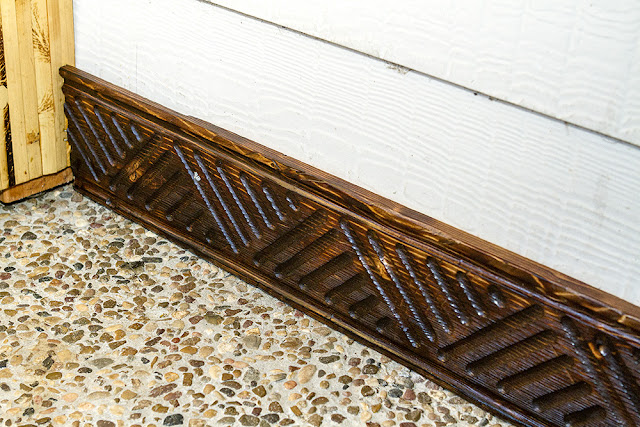
At this point, I enter uncharted territory with my tiki build. A popular and common component of home tiki bars are carved baseboards and other assorted trim. I have a full-sized router that I've used on my office build, mainly to carve out dados for bookshelves, etc. It's large, however, and not entirely suitable for the more intricate design work of carving baseboards. So I went to Harbor Freight, that emporium of cheap tools imported from China, and picked up a super-inexpensive trim router using a 40 percent off coupon. This small router isn't nearly as powerful, and I doubt it will last as long as my other (15 years now) but it's nimble and better suited for detail work.
I picked up some 1"x6" Ponderosa pine boards from McCoy's (they were cheaper than at the other options, plus the boards had a smoother, more polished finish as opposed to the rough cut of other places). I designed a simple, common alternating triangle pattern using Photoshop and printed it out. Using an Exacto knife, I trimmed out the pattern then traced it onto a more robust piece of poster board. After trimming that out, I taped it to the boards and traced the pattern onto the wood. If that sounds like it's convoluted, or a lot of steps, well, it is.
One thing that's nice about the trim router is that it has a guide attachment that allows one to cut a groove at a set distance along any straight piece of wood. My big router doesn't have that, and to get straight lines I have to measure and clamp down a guide board that's both straight and long enough... it's a pain. This is much more effective, although I have to confess that on my first attempt I didn't bolt the guide tightly enough, and it came loose resulting in an irregular cut. But don't tell anyone.
Once the straight-line grooves were cut (I'm using a quarter-inch half-round bit at little more than an eight-inch depth, for those interested in such things) I set to work on the triangles. Each triangle is made up of six parallel cuts in progressively shorter lengths. As they're oriented at 45 degrees to the edges of the boards, setting up a dependable guide would be more trouble than it was worth. After a tentative experiment on a piece of scrap wood, I knew that I was not yet experienced enough to make the cuts freehand.
I ended up splitting the difference, so to speak, and used a short, straight piece of wood as a floating guide, holding it down with my free hand. This turned out to be remarkably efficient. I ended up taking about two and a half hours to rout the first 8' board, and only around an hour to do the second. This is one area where experience pays big dividends. The work went very much faster (with fewer missteps) as I progressed.
Next up, fire! On all the big home bar build threads over at Tiki Central there are references to artificially aging the wood used for trim, so it has a rustic, live-in look. The first part of this involved roughing up the carved wood with an angle grinder. Once again I headed to Harbor Freight with a 40 percent off coupon and picked up a cheap angle grinder. With the spinning heavy-grit wheel I gouged and grooved and scuffed the boards until they looked like they'd suffered 40 years of neglect in some out-of-the-way dive. Then I applied my little propane torch. I picked this up back in December to heat-tree the bamboo I'd started harvesting (which is something I've yet to discuss on this build-along. I will have to rectify that in the future). I wasn't sure what to expect. How much should I burn the wood? How black should it get? Am I going to start a huge fire and have to evacuate the neighborhood?
Fortunately, once you clear away all the sawdust (this is an important step, so don't skip it--sawdust is eager to burn) the wood is reluctant to burn as long as the flame keeps moving. It doesn't even have to move fast. I just brushed it back and forth like a gentle paint brush. Some parts of the pine darkened instantly, while others held onto their light coloration despite multiple passes. You're not burning the wood so much as scorching it.
At this point, I still wasn't sure if I was doing this correctly, or what the real point was. I applied a wire brush--the same type used to clean a barbecue grill, or used in welding if that's your thing--and rubbed down the scorched wood. The results were dramatic. The blackened, carbonized areas came off as soot, leaving the wood a much more uniform brown. But the biggest change was in the wood's texture. I've seen references to applying flame to "raise the grain" but didn't quite grasp what that meant. Give it more visual contrast? Expand it? Well, I'm here to attest that "raise the grain" is to be taken literally. Whether the grain actually rises or the softer wood between burns away is irrelevant--the end result is a wood surface with dramatically enhanced surface texture, akin to old barn wood that's been exposed to sun and wind and rain for 30 years. Only this way, you get the aged wood appearance without the cracks and rot that accompany exposure.
After cleaning away all the soot and sawdust, I stained the baseboards with Minwax Special Walnut and then applied a couple coats of Spar Urethane to protect the wood from moisture and the elements in general. I've posted so many dull stain and varnish photos for other projects that I'm not going to waste the space repeating. Just imagine several days have gone by and it's all dried nicely, okay?
Returning my attention to the back bar, the bar surface desperately needed trim applied to at least look complete. Since my intent is to match my original tiki bar design as much as possible, this meant getting some 3" moso bamboo clums from Bamboo Branch in Austin. Since I'd learned a lot more about bamboo than I did last year when I built my original tiki bar, I knew I needed to heat treat the culms to give them a richer color and bring out the contrast at the nodes. I have to say, burning 3" culms with my little propane (butane?) torch is a lot more time-consuming than the little 1.5" culms I normally work with. It takes more heat to reach critical mass and achieve the color change with the thicker wood. The result is very nice, and worth the effort.
The surface of the back bar, with the plywood base and laminate surface, is right around one inch thick. I took masking tape and, laying the culms straight, applied the tape to act as a straight cutting guide. Splitting bamboo in half is relatively straightforward, but cutting a strip out of a culm is more of a challenge. I haven't see how other folks do it, but I used a jig saw with a fine toothed blade to make my cuts. When I got to the solid nodes, I lifted the back of the saw to go into it at a 10-degree angle, and that seemed to work well. Once I got both sides cut and lifted the strip out, I used a small hammer to knock out the remaining node wood so the culm would fit on the bar top better.
I test-fitted the culm, and used the jig saw to trim away any areas that were sticking or in the way. Once I got the pieces going on the bar satisfactorily, I measured and made 45 degree cuts on the bamboo trim using my mitre saw for the corner joins. I used long paneling nails to attached the bamboo edging to my tiki bar, and honestly, that was a mistake. Those nails weren't strong enough to hold the bamboo steady, and there's been progressive shifting ever since. This time, I saw no other option than to use heavier wood screws. This meant drilling a pilot hole, then using a bigger bit to cut out a countersink hole.
After attaching the bamboo culms with the wood screws, I covered them with wood putty. The next day, once the putty was dry, I sanded it smooth with 220-grit sandpaper and applied some Minwax Special Walnut stain. The screw-holes are less obvious, but still not invisible. I'll apply some dark walnut when I have time and see if that helps it blend in better with the scorched area of the nodes.
One big downside of how nice this bamboo bar trim looks is the fact that the trim on the tiki bar--which I built before learning about scorching bamboo to bring out color and contrast--looks dull and dowdy in comparison (as can be seen to the left in the final photo of this post). I don't relish the thought, but as some point I'm going to tear apart the original bar, sand down and scorch the bamboo trim to give it the same pop as the back bar.
With the bar trim in place, I was ready to install the baseboards and bamboo tambour panels. You know, show some actual visible progress. A sticking point is the siding on the patio--it's overlapping fiber cement, which is nice and durable but not conducive to flush application of veneers. To compensate, I bought several 8' furring strips and sliced them lenghtwise on my table saw at a 4 degree angle (give or take). The thick end of each trimmed strip is about a quarter inch thick, which matches up with the overlap end of the siding. The 4 degree cut, when attached to the siding, presents a vertical surface upon which I can apply far more interesting veneers. I coated all the cut strips with Flood CFW-UV for added protection, even though they won't be directly exposed to the elements. Furring strips are notoriously non-durable, and I don't want them rotting out on me.
I attached the baseboard using a 1.5" exterior grade wood screw, drilled through a pilot hole into the backing furring strip. I need to go back with dark brown paint and cover up the gray screw heads, which draw the eye. I'm not going to caulk this, because there may be some reason in the future to remove the baseboard and/or wall covering. Not that I plan to, but that's the approach I plan to take.
I remember now that I forgot to mention one thing when discussing the routering of the baseboards above--on the backside of the boards I cut an eighth-inch deep, half-inch wide groove along the top side of the board. Why? To serve as a pocket into which I shall insert the lower end of the bamboo tambour panels. I placed a cut furring strip against the siding corner nearest the top end of the tambour panel (I'm fastening the strips to the wall with exterior wood screws, if you haven't guessed) and then did a test fitting of the tambour. Unfortunately, the bamboo slats in the tambour are fairly thin, and bulged out in the middle, which necessitated a second furring strip in the middle. Once everything lined up, I stapled the tambour into place, taking care to fit the staples between the slats. This is the same process I used on the back bar itself, although I coupled that with glue. Glue is not practical in this situation, and even if it were, I'm making the wall coverings so that they can be removed fairly easily if necessary. At some point I'll come back with tan paint and a fine-tipped brush to disguise the handful of staples that are visible, but for the most part they can't be seen unless you're actually looking for them.
This is a little out of place, but I forgot to include it in my earlier installments. In addition to the wall coverings being removable, I also built the back bar to be removable. It's solid and not going anywhere on it's own, but since I plan on adding a sink, I don't need any accidental shifting disconnecting the water or drain lines. But I didn't want to permanently affix it to the wall with nails or screws. I settled on eye hooks on either end. The anchors are small but surprisingly solid. The back bar's not going anywhere, but it was a snap to pull it away from the wall to facilitate the installation of the tambour panels.
And this is the end result, kinda sorta up close. I like that I decided to go with the tortoiseshell pattern. It adds visual interest. And by cladding the back bar in tambour, it looks of a piece with the wall.
And here's a slightly wider view, placing the back bar in the larger context, with the tiki bar front left. Before the tikification began, there were quite a few elements of the patio that we either didn't pay attention to, or thought were kinda neat on their own. As my upgrades continue, those elements are starting to clash badly. Case in point: That round porthole window. We thought it cute when we moved in, but it's damn ugly in context now. The Wife and I discussed this last night. We like the concept, but the execution is pretty bad. I'd thought to put that off for a good long while, but now I think I'm going to have to tackle it sooner rather than later. Complicating matters is the fact that it's a really large window, and available nautical-styled portholes, be they authentic or fake, are generally quite a bit smaller than needed here. I'm sure I'll figure something out, but nothing is ever easy...
Now Playing: Stan Getz The Bossa Nova Years
Chicken Ranch Central
Wednesday, June 07, 2017
Tiki build-along, pt. 6
So, last update I'd completed the frame of my back bar and attached the bar top. Next up: Bamboo tambour panels. I realized early on that my tiki bar build, being outside, would attract all manner of dust, dirt, insects and assorted debris. This necessitated serious attention to ease of cleaning and materials that wouldn't collect the crap so readily. I'd originally intended to line the walls with bamboo fence wainscotting, but the more I thought on this the more I realized that would just provide harbor for all sorts of spider webs, wasps and random gunk to hang out in. Then I came across this thing known as tambour panels. I'm still not clear on the origins of the name, but essentially these are rolls of flat bamboo slats attached to a cloth backing. Think of it as flexible wood paneling. The price was right, it appeared easy to work with and it came in a variety of aesthetic styles. I chose tortoiseshell bamboo, which I felt matched the look of the bamboo culms I'd harvested and torched on my own (more on that later).
Here's a closer look at the pattern. The bright sunlight washed out much of the color, but it really is an attractive bamboo. I coated both sides of the panel with weather protectant because, again, while they'll be sheltered from direct exposure to the elements, humidity still varies wildly and my experience with the outdoor speakers showed that reflected UV was a significant issue. I learned during this process that many weather sealants are penetrative, that they depend on being absorbed by the wood surface to work internally. Bamboo doesn't like to absorb such things, so surface treatments are most effective. Live and learn.
Around this time, I decided the back bar should match the wall. I knew I wouldn't use a palm thatch front like on the existing tiki bar. I thought I'd go with bamboo, but that thinking changed to using the tambour panels for the back bar as well. That would unify the look of the back bar and the wall. Being easier to work with was no small factor in the decision as well. The first step was to remove the three cabinet doors from the back bar so I could cut the tambour to size and attach it. Below is the largest door, the one covering the water spigot and propane connection. Since we use that spigot regularly for washing down the patio, adding water to the pool and watering plants, I needed to include storage for the water hose. I attached a hose rack to the door, because this kept the hose out of the way of other things that need to utilize that cabinet space.
The downside of having the hose rack on the door is that the bolt heads stick through the front. I'm sure there are other solutions, but I couldn't come up with any during the build, so this is what I'm working with. A surface that's not smooth. I applied a goodly amount of Titebond III to the edges, corners and space around the bolt heads. As I've written elsewhere, Titebond III is relatively expensive, but close to the strongest wood glue you can buy.
I filled in the remaining space with Titebond II, which is a pretty strong glue in its own right, then used a folded scrap of paper to spread it all evenly across the door.
After that, I applied the cut bamboo tambour panel to the door and wiped away excess glue oozing between the slats before I clamped it down. There was lots of glue, and the last thing I wanted was the boards I was using to clamp the tambour down getting glued to the door as well. So I laid wax paper across the tambour, then laid down scrap boards and finally clamped everything down for 24 hours.
I'd used magnetic clasps to keep the doors closed on the back bar, and earlier had learned they weren't easy to open with my bare hands. They needed handles. Fortunately, I had a lot of moderate-sized bamboo culms drying in my garage I'd harvested back in December and January. I'd torched most of it, so there were some attractive pieces to work with. I picked out three bamboo joints that were roughly 1.75" thick and 6"-7" long to serve as handles. Here's where things got dicey: I didn't know how I'd make them into handles. I had a vague notion, but I didn't know if I could make it work, or if the bamboo would even tolerate my abuse. I marked the bamboo where I wanted the support bolts to go, and drilled that out. Unfortunately, despite knocking out the solid piece in the bamboo nodes, there was not enough leeway to get the 2" long screw and washer into place. So I drilled the hole out at an angle from the inside, going through the node (below).
This made things much easier. I could slip the bolt directly into the hole through the node now, but since the drill hold was much larger, I worried the bolt head would tear through the bamboo when tightened/stressed. So I added a washer to the bolt. Now the bolt wouldn't fit through the node opening, so I ended up slipping the washer in first, then fishing around inside the bamboo with the end of the bolt until I speared the washer, then sliding the combo through the hole. Repeat this six times.
Everything after that was amazingly easy, which is to say, not at all the way my projects usually turn out. I marked the locations of the handle bolts on the cabinet doors and drilled holes through the doors. I found a slender length of bamboo I'd torched and cut half-inch segments with which to sheath the bolts for aesthetics. Then I slipped the assembly through the door holes and tightened them on with a nut and washer combo. I tightened then enough so that the washer inside the handle bent into a U shape. They're locked in pretty solid. I don't think they're coming loose any time soon.
The end result is pretty sweet-looking, I think. The beauty of it is that if it ever starts coming loose, I can simply re-tighten the nut on the door and not worry about the screw head. It's pretty immobile. The only blemish is the open nodes on the handles. I intend to close these up at some point, otherwise the cavities will attract mud daubers, spiders and the like. I'll likely use an almond-colored silicone sealant, because in my experience with the tiki bar, basic wood putty cracks under stress. There may be a better option out there, and since I'm in no rush to finish off that portion of the build, I may well try something entirely different once all is said and done. But still, progress!
Now Playing: Dire Straits On the Night
Chicken Ranch Central
Wednesday, May 24, 2017
Tiki build-along, pt. 5
Tikifying my outdoor speakers isn't the only thing I've been up to. Progress on the back bar continues. Once I had the frame put together, it came time to waterproof it. I didn't use more durable, pressure-treated wood, because 1) the chemicals in such wood doesn't always interact nicely with metal, such as that found in nails, screws, fasteners, etc. and 2) the chemicals in such wood doesn't always interact nicely with human bodies (even though copper-based preservatives have largely replaced arsenic-based ones). Considering the fact that this would be a food preparation area, more or less, I wanted to go with something slightly less worry-inducing. In the end I went with Flood CWF-UV, not because it's food-safe (it isn't) but because I had some on hand. Budget-conscious, I am. But it's less threatening than arsenic/copper, so let's go with that.
Up and down, I coated the entire frame. The bar will be sheltered from direct exposure to the elements, but I don't want to have to worry about rot or mold. There's already a water spigot here, and I plan to make it a wet bar, so the potential for constant moisture and spills is not something to dismiss. The fact that the Flood is cedar-tinted made it easy to keep track of my progress--and see if I'd missed any spots.
Once I finished connecting all the legs, I realized that the pebble-concrete floor was not level. I didn't really want the wooden legs to stay in constant contact with the concrete because of the potential for wicking up moisture, but this clinched it. I needed to put leveling feet on the bar legs. Unfortunately, I couldn't find any of the heavy-duty all-metal ones I've seen in the past (just call me Mr. Over-engineering) so had to settle for some plastic anchor ones. You can see where I drilled out the hole to accept the footing anchor.
And here is the adjustable leveling foot inserted. I'm happy to report that the plastic anchor is holding up, and the leveling function is working properly. No unstable bar for me!
With the legs taken care of, it was time to tackle the bar top. If you'll recall from the start of this project, the size of the bar was determined by a 20" x 8' piece of plywood I had leftover. After coating it with the Flood weatherproofer, I positioned it atop the bar frame so that there was a 4" overhang on three sides, resting flush against the backing wall. I then used my drill--which I've had for close to 30 years and gets more use than any other power too I own--to make pilot holes and then fasten the plywood bar top to the frame with 2" outdoor wood screws.
And this is what it looks like. It's starting to be identifiable as a bar, no? I should add that somewhere along the line I attached the cabinet doors with hinges, screws and magnetic closures. They were all coated with Flood as well. I didn't take any photos of that, but I'll trust your imagination to fill in any gaps.
The plywood wasn't high-grade finish. I could have tried to sand it down and build it up to a smooth finish by applying many coats of polyurethane, but I did some of that with the initial tiki bar build last summer, and discovered it's a whole lot of work for minimal returns. That's why I went with laminate flooring for the bar top in that build. Following that route again had the added bonus of matching the back bar top to the tiki bar top, making the two look of a set, like I cleverly planned all this out from the start. Using the glue I had on hand, I spread Titebond III (the really, really strong stuff) along the corners and edges of the plywood surface, and filled in everywhere else with Titebond II (which is merely really strong). It's not my desire for the bar top to separate, you see.
Our entire house is floored in this crummy faux-pine hardwood laminate. Since I'm in the middle of my office build-along and replacing the floor (from whence the tiki bar top came) it was a straighforward matter to cannibalize more flooring from the office. I was able to pull up a section that was almost exactly 9'x4' which was plenty big to cut out a top for my back bar. A quick side note--one of the big reasons we hate this flooring so much (and we generally like laminate) is that it has very little texture and is very, very noisy. Not at all like the laminate we installed in our previous home. I've since discovered that this is actually a thing called "laminate tile" or somesuch, which is much thinner than traditional laminate flooring. It's also unpadded. Those factors combine to give it all the traits we dislike about it. But it makes for a decent bar top. I'll mix a drink on it, but I wouldn't want to walk on it. But it cuts easily enough with a jig saw, so that's what I did.
Then I used clamps and boards and random heavy things I had lying around to secure the laminate to the glue-coated surface of the plywood top. And squeezed it on real tight. The fit was just about perfect. I wiped up any oozing glue and left it secured that way for 24 hours.
And here it is without the clamps and assorted dead weight. The mini-fridge is about 21" deep, so once the trim is in place, everything should fit just about perfectly. It still doesn't look like much, I know, but I'm about to start prettying it up. It's going to look good--trust me on this.
Now Playing: Christopher Franke Babylon 5: Messages from Earth
Chicken Ranch Central
Subscribe to:
Posts (Atom)


