Showing posts with label grafting. Show all posts

Tuesday, February 21, 2017

Thrill of an early spring, redux

Spring is breaking in Central Texas, and I'm scrambling to keep up with the various plants breaking bud hither and yon. This is not a new experience for me. Consider what I wrote here almost one year ago:

We haven't had much of a winter this year. That's both good and bad. Good, because I absolutely hate the cold. The reason I tolerate the brutality of August in Texas is so that I might wear shorts outdoors in January and February. On the other hand, it's not that great for my fruit trees, which need a certain amount of chill hours annually to produce good crops. That's not a big deal yet, because we've only lived at the new house about 18 months and the trees I planted last year are still too young (for the most part) to bear fruit. Last year we recorded almost 1,000 chill hours, which is a significant amount for this part of Texas, which is more than enough for any of the fruit trees I have growing. This year, even with the mild winter, I'm at 600 chill hours--a decent amount for most of my plants.
This year, I'm sad to say, we're not even at a meagre 300 chill hours--just 293 at last reading--with little hope of gaining any more at this point. That is discouraging, to put it mildly. We had two big freezes this year, and one dropped down to 22F doing significant damage to some of my plants, despite the fact that I'd covered them and/or added heat lights. Last year we never had any hard freezes, but it stayed chilly for long stretches. Without sufficient chill, fruit trees won't produce. Most of mine are still too young to worry about that, but if this trend persists through the coming years, it will prove problematic.

What's not problematic are my passion vines. That big flower bud above is from my potted passiflora vitifolia, aka the crimson passion flower. It's already bloomed once in February and has set a bunch more buds. Out in the yard, my passiflora incarnata, aka native maypops, are popping up all over the place after freezing back during the winter. So some plants are happy with the warming trend. Others have a chance to get an early start on the growing season. Below, you'll see the haul I got in from the T.V. Munson vineyard at Grayson College. For the uninitiated, Munson was a horticulturalist who set up shop in Texas back in the 19th century and bred hundreds of varieties of grapes. He's also credited with saving the French wine industry. Many of the grape varieties he bred used wild stock and are particularly well-suited to growing in Texas, where other domesticated grapes struggle due to climate, disease pressure, etc. Sadly, almost all of Munson's varieties are not available commercially, but the good folks at Grayson sent me cuttings of Elvicand, Ben Hur, Valhallah and Wapanuka. I treated the cuttings with rooting hormone and currently have them warming in moist sphagnum moss to encourage the formation of rooting calluses. In about a month I'll plant them in pots and if all goes well, should have a bunch of vigorous (and rare) grape vines growing by the end of spring.

I also put some effort into propagating the Ison muscadine growing in my back yard. Muscadine grape vines do not easily root from cuttings, so one has to air layer the vines. This involves wounding part of a vine near a bud node, treating the area with rooting hormone (not strictly necessary, but I always do so), and then enclosing the wounded area in a growth medium. In the past I did my air layering using starter pots and tying the vine down... actually, it was pretty labor intensive are my failure rate was high. I saw online this alternative method, which involves cutting the bottom out of a liter bottle and just running the vine straight through, then filling with soil. It certainly is a lot simpler. Time will tell if it is more successful.

Last year, a great deal of my time was spent grafting apple trees. I didn't graft that many this year, but I still did some work in that area. Out front, I have two young Blanco crab apple trees planted. Or rather, did. One abruptly died last fall, and I'm still unclear why it died. To hedge my bets, this year I took some of the pruned branches and grafted them onto the two dwarf apple trees I so vigorously grafted onto last year. You can tell the Blanco crabs aren't domesticated because they've got some serious spurs on the branches.

A few razor cuts later, and the graft is completed. I use cheap electrical tape had have good results. I wrap tightly from the bottom up, then counter-wrap from the top down with a second piece of tape, that way, if the tape starts to unravel (and it does) the top layer has to unravel a lot before the more important bottom layer can come loose. In the end, I did seven Blanco crab grafts. I also found a branch on my young Arkansas Black apple tree had broken, but was still attached to the tree. I pruned it off and used the good sections of the broken branch to make two more grafts on the dwarf trees. I lost the first Arkansas Black I planted two years ago to drought, so insurance is always good.

This is the simple cleft graft process I use. It's the simplest form of grafting, but I've had excellent success with it. The base of the scion wood is cut into a narrow V, and inserted in a narrow wedge, or cleft, of the tree. Out of the dozens of grafts I made last year, almost 100 percent took. One Hall apple graft started to grow, but abruptly died. Then later, I accidentally broke off a King David graft that was growing vigorously, with no hope of saving it. So, that's a pretty good success rate.

This is what the cleft graft should look like a year from now, when the wound is scarred over and the graft is growing as a solid part of the tree.

The graft union doesn't always grow so neatly. Here's one that's bursting forth through the electrical tape from last year. The tape's not really strong enough to strangle the limb, but it is restrictive. After a year, once the union has properly healed, the tape should be removed.

And this is what it looks like when the tape is peeled away.

I also had two apple salvage jobs left over from last year. I ordered four crab apple trees to go along with the two Blanco crabs out front. Two were Hewe's Virginia crab, and two were Wickon's crab. Alas, the Wickson grafts were DOA, leaving me with only rootstock, and my beagles broke one of the Hewe's, leaving me with just one of the preferred types I'd ordered. Fortunately, the surviving Hewe's put out several branches and I was able to graft parts of them onto the two surviving root stocks. Because these are growing in pots, I was able to get cute and use wax to seal the ends and prevent water loss that way. Not necessary, but always an option.

So, what else is new at the Blaschke homestead for 2017? I'm glad you asked. Whilst I have a couple of paw paw trees, a che and several banana cultivars still in pots waiting on me to prepare their planting areas appropriately, I've managed to put several other new fruiting plants in the ground. The scrubby bush below, in the tomato cage is not new, though. This is a two-year-old goji bush. It struggled the first year in the ground but came on strong last season. I planted another type nearby last year, and it struggled as well. I'm hoping it catches up to its older sibling this year.

s

This one is new. It's a "Sweet Scarlet" goumi, otherwise known as elaeagnus multiflora. A relative of Russian olive, this one's not supposed to be invasive. It's also a nitrogen-fixer. I've planted two. It just now occurred to me that I also planted a new pineapple guava (feijoa) last month, the named "Mammoth" cultivar. No photos of that one, though.

I also finally got around to planting my latest jujube tree--the hard-to-find "Honey Jar" cultivar. Theoretically, it's my last jujube. I have a li, Shangxi li and Black Sea already in the ground, and the li produced several fruit last year. I'd kinda like to get Tiger Tooth and Sherwood types, but this one will be enough for the forseeable future. It's kind of hard to see in the photo because of all the branches. That's what's left of the out-of-control Lady Banks rose bush the previous owners planted and then never trimmed back. The darn thing had a trunk six inches thick, I kid you not. There's a lot more of it outside the frame. I'm going to be mulching this one a long time.

Next up is a Sumbar pomegranate. It, and the Austin pomegranate about 10 feet away are already leafing out. They're both sweet types, so I need to get some more tart types to balance them out. The common "Wonderful" variety doesn't grow well in the Central Texas climate. Fortunately, I've got some cuttings heading my way of the somewhat obscure Kajacik Anor cultivar. I sampled this one at the A&M pomegranate tasting earlier this year, and it was my favorite of the lot. Hopefully I'll be able to root a few cuttings.

Remember those hard freezes I mentioned earlier? They hit my bananas hard, but fortunately the fruit that had already set survived, as did the plants. Not so lucky were my mandarins. Two years ago I got the new Orange Frost and Arctic Frost satsumas, cold-hardy types that had been developed in San Antonio and actually growing in the SA Botanical Gardens for decades, surviving repeated hard freezes. Unfortunately for me, those were mature trees and mine were anything but. Even covered with a frost blanket, these took a serious beating. The forecast was for 28F, which they'd weathered a few weeks earlier without any trouble. But dropping down to 22F and staying there for the better part of a day killed all the leaves and most of the branches. Fortunately, the lower branches survived and are now leafing out. These types are grown on their own roots, so I don't have to worry about the rootstock taking over. The next time we have a hard freeze coming, I'm going to wrap them with hot Christmas lights, like I did my bananas.

The panache tiger fig is another new addition this year. These are the nifty-looking yellow-and-green striped figs you sometimes see in the fresh produce section. It started leafing out before I even got it in the ground. I had great success with the unidentified open-eye fig at the old house, but that open eye attracted all sorts of flies and wasps. I ended up getting stung several times, so I'm all about the closed eye fig these days. I hope to add a couple more types, but deciding on the best option for my needs is not that easy.

My other fig, a Marseilles Black grown from a cutting I traded for years ago at the old house. It's been in a pot ever since, and not terribly happy about that fact. It's been in the ground for a year now, and while it leafed out all summer, producing a few small figs, it had very little growth. I'm assuming it spent last summer investing all its energy into growing roots. Regardless, the 22F freeze that hammered my mandarins killed this one back as well. It didn't die back all the way to the ground, though, and already I see new growth breaking out. It'll be interesting to see how much it grows this season. I'd like my figs to grow large enough to act as a privacy screen (along with the rest of my fruit trees).

This coming year I hope to get a few kumquats to plant along the driveway, a replacement for my dead Blanco crab, a weeping mulberry (or two) and a dwarf key lime to grow in a container. There are some dwarf papayas that would look quite nice in a container as well. Oh, and I also have some Texas (remote) Pinion Pine tree seedlings on order. So I should keep busy for the next six months or so.

Now Playing: Jimmy Buffett Buffett Hotel
Chicken Ranch Central

Thursday, March 10, 2016

Grafting revisited

I feel the need to clear up a misconception I've encountered with growing frequency: I don't have a green thumb. I'm not terribly good with plants. If it's in a pot, odds are that I will kill it sooner rather than later. Not through abuse or neglect, mind you, but by doing everything I'm supposed to in order to assure perfect growing conditions. I've killed countless types of passion flowers this way. Conversely, if I plant something outside, in the ground, where it can generally fend for itself without my constant attention, then the plants do pretty well for themselves. Hence my acquired preference for fruit trees. That image to the left? That's a little fly camped out on blossoms of my Santa Rosa plum. I planted this plum tree last year (we had a dwarf version at the old house) and it always produced a brilliant display of popcorn-like blossoms in early spring, followed by dark red, sweet-tart fruit. I might actually get a few plums off it this year. That would be nice, although the other plum tree isn't blooming so I don't know what to expect regarding cross pollination.

What I'm really jazzed about are these next two images. Take a look. The first is of the Hall apple graft on the old dwarf apple tree on the south side of my yard, and the second is of the Yates apple graft on the old dwarf tree on the north side of my yard. Cleft grafting is the easiest type of grafting there is, apples and pears are very cooperative when it comes to grafting, and I've had great success with it in the past. That said, there's always a period of uncertainty in the early spring when the grafted wood is dormant and I'm left to worry "Is the graft taking? Is the wound healing? Or is the bud wood dead and the graft a failure?" It's not until the buds break on the grafted sticks that I can exhale a little in relief. There are things that can still happen to ruin the grafting attempt, but the biggest hurdle is past. I also had bud break on a Hewe's Virginia crab apple bench graft I got earlier in the spring, which I'm happy about. Now, all I need are the other nine grafts on the two trees to show signs of active growth and all will be well.

Hall heirloom apple budwood graft

Yates heirloom apple budwood graft

Other times, the graft doesn't waste any time letting you know it's happy. This image below is of a Meadows pear scion I grafted onto my Purdue pear tree about four weeks ago after getting the wood through a trade with another grower. Once it finishes flowering I'll pick them all off to ensure the scion doesn't try to make any fruit. First, the fruit would break the fresh grafting union before it completely healed, and secondly, I want the tree to put all its energy into growing the graft this season. But it's still nice to see such obvious early success.

Elsewhere, I've got an agarita bush in the front yard in full bloom (below). I hope to add more of the tart-berried native plant in the future. The fruit makes a great wine and the plant is drought-tolerant and simply wants to be left alone (the sharp thorns on the holly-like leaves are testament to that). Second down is the Galaxy peach I planted last year in bloom. It's blooming a lot. Supposedly these garish, magenta blossoms are self-fertile, but just to be sure, the Red Baron peach about 15 feet away is breaking out into some serious color as well. Most everything else I have is still dormant, but with the warm weather and recent rains, I expect everything to be breaking out any day now.

Now Playing: Pink Floyd Delicate Sound of Thunder
Chicken Ranch Central

Tuesday, February 23, 2016

Thrill of an early spring

We haven't had much of a winter this year. That's both good and bad. Good, because I absolutely hate the cold. The reason I tolerate the brutality of August in Texas is so that I might wear shorts outdoors in January and February. On the other hand, it's not that great for my fruit trees, which need a certain amount of chill hours annually to produce good crops. That's not a big deal yet, because we've only lived at the new house about 18 months and the trees I planted last year are still too young (for the most part) to bear fruit. Last year we recorded almost 1,000 chill hours, which is a significant amount for this part of Texas, which is more than enough for any of the fruit trees I have growing. This year, even with the mild winter, I'm at 600 chill hours--a decent amount for most of my plants. Compare that to the 470 chill hours received this year at our old house, just 10 miles to the south. I chalk the difference up to our new place being on the edge of the Hill Country. Our elevation is approximately 800 feet above sea level--almost 80 feet higher than old house, although it doesn't seem that much. Amazing how dramatic such a small shift affects one's climate!

In any event, winter never took hold here, and the extended autumn was fairly feeble as well. We never had a serious freeze in the entire month of February, traditionally (in my experience) the coldest month of the year. Temperatures have been in the 70s-80s for more than two weeks, and everything in my yard is waking up from the annual slumber. The two photos above are of my young peach trees--a Red Baron and a Galaxy--swelling up their buds for a looming garish display of flowers. Perhaps this year I might get fruit. Peaches are precocious, after all. More remarkable is the leaf bud in the image below. That's a shipova, a rare hybrid of a European pear and something called a whitebeam. They originate in Eastern Europe and are pretty exotic. I'm trying my hand at keeping this one alive despite the plant's questionable resistance to fire blight. Interestingly enough, this plant came to me from northern California and has only been in the ground a week. My warm weather has shocked it (and a Black Sea jujube I planted last week) into leafing out.

This next one is even more impressive. It's a medlar, a fruit tree popular in medieval times that's mostly an ornamental curiosity these days. I planted it two weeks ago, and the little thing broke bud almost immediately and has grown two inches. That may not sound like much, but the bareroot twig I planted was barely a foot long, not including the roots. If it maintains this rate of growth, it'll replace those two hackberry volunteers I cut down to make room for it in no time. I hope to add a few more medlar varieties in the next year or so.

The thing about our new house is that the previous owners had it on the market, off and on, for almost three years. During that time they had moved out, and invested zero effort into landscaping beyond mowing the grass on occasion. In most instances this wouldn't be a big deal, except that they'd planted lots of Carolina jasmine and Lady Banks roses around the perimeter. That stuff grows like kudzu normally, so over the course of three years it utterly took over. I've grown to loathe it, and shall one day chop it all out. But as I was trimming some of the worst of it back last spring, I discovered two dwarf apple trees completely buried by those bushes. They fruited in the spring, and I'm pretty sure they're Ein Shemer apples, a low-chill, low-quality apple that originated in Israel. I didn't want mealy, bland apples, but the mature trees have well-established root systems and have proven able to survive drought without any care at all, so last I hatched a plan to repurpose them: I'd graft better varieties onto them, and get good apples.

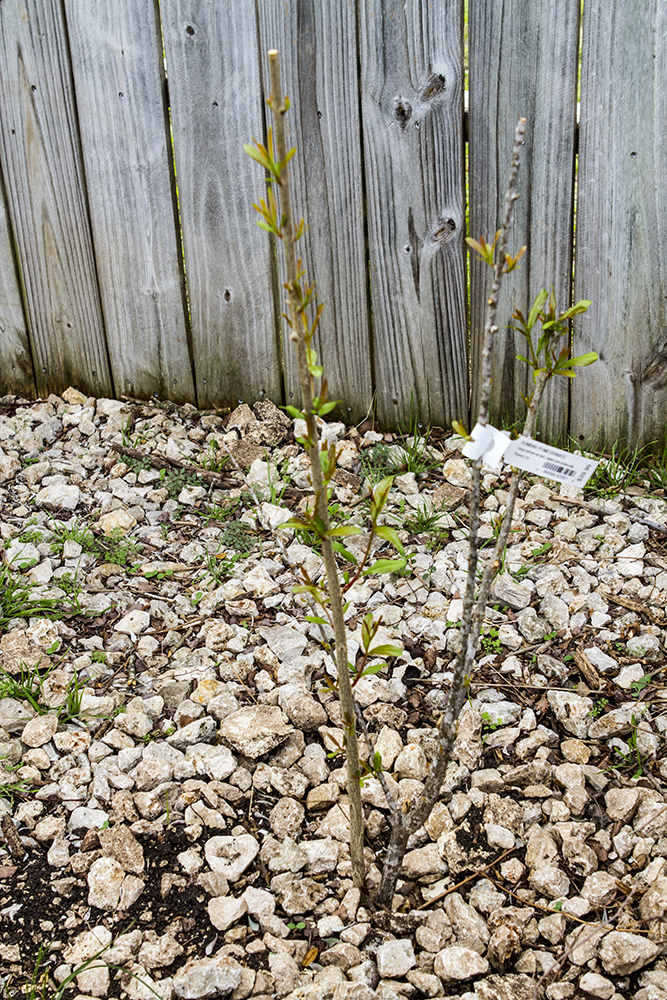
Grafting is something I taught myself at the old house with a couple of pear trees I planted. I was shocked at how easy it is--at least with pears, and I've yet to find anything that says apples are more difficult. Grafting involves attaching scion wood from a different cultivar or closely-related species so that it grows from that point on as part of the tree. Simple as that. Some trees are harder to get a successful graft to take than others, but for the majority of fruit and nut trees, it's the way popular varieties are propagated. A month ago, I ordered 10 different pieces of scion wood representing different heirloom apple types from Big Horse Creek Farm. Those scions arrived a few days ago, and I've been busy.

There are a number of different grafting techniques, but thus far I've stuck with the most simple, the cleft graft. Why? Because it's easy and I've had great success with it. Out of several dozen pear grafts, I've had two fail, and I suspect that was because I waited too late in the spring to attempt the graft. I've also had one peach graft fail. Not a bad track record. The scion wood I received was little more than a foot long, so I was able to cut each piece in two and make 10 grafts per tree. The cleft graft is pretty self-explanatory. Find a branch on the tree that's the same size or bigger than the scion. Cut the branch off, then using a sharp blade, slice an inch-long cleft right down the center. A sharp blade is important. I used to use pocket knives, but the wood dulled the blade quickly. I've since switched to utility knives with sharp blades easily replaced when they start dulling. A word of warning--the blade normally doesn't want to go into the branch to make the cleft, but once it gets a bite, it can slice through quickly. If you're not careful, you can either slice through the branch, or worse, your hand. I speak from experience.

With the scion wood, trim the base end (not the growing tip end) into a V shape. This isn't rocket science, but it's best to get the cuts straight and smooth. That can be a challenge if there's a bud in the way, but in my experience it's easier to get a good V cut than an even cleft cut.

Next (tell me you didn't see this coming) wedge the V into the cleft. This is your graft. The absolute most important thing is to make sure the cambium layer of the branch lines up with the cambium of the scion. The cambium is the green, growing layer beneath the bark layer. This is the living, growing layer of the tree. Properly aligning the two ensures that nutrients from the tree flow into the scion wood and keep it alive and growing. Cool, huh? If you have a larger branch than scion wood, never fear, just align the cambium on one side of the graft. Trees aren't picky--usually just that limited amount of contact is enough to make a successful graft.

After the cleft graft is properly aligned, it must be wrapped. There are special grafting tapes and grafting compounds available to seal the wound and prevent drying out and other such hazards that could cause the graft to fail. I don't use any of those. Nothing against them, but I've not ever attempted grafts on trees that are difficult to graft. I use simple electrical tape and have had an outstanding rate of success. I wrap the tape loosely at the ends, and then tightly over the graft itself to apply pressure and ensure better contact between the two cambium layers. Then I apply a second layer of tape in the opposite direction to prevent unraveling. Electrical tape stretches, but only so much. If it doesn't deteriorate quickly enough, it could potentially girdle the branch and destroy that graft that you worked so hard to establish. I try to remove the tape after a year, but there's a lot of leeway here. With grafting tape, you don't have to worry about girdling.

What does a successful cleft graft look like? It looks like the image above. I made this graft in the fall of 2014, using scion wood from a Warren pear I had growing at the old house and an Ayers pear tree I'd planted at the new house. The join is solid, but you can still see the distinct V and cleft of the separate pieces of wood. Hopefully, my apple grafts will look as good a year from now.

But what are those grafts? Ah, I thought you'd never ask. For the record, each tree has two Hall apple grafts, one Carter's Blue, one Husk Sweet, one Keener Seedling, one King David, one Pink Pearl, one White Winter Pearmain, one Winesap and one Yates. These will supplement the Royal Limbertwig, Arkansas Black, Reverend Morgan, two Blanco crabs, two Hewe's Virginia crabs and two Wickson crabs I have growing. That gives me a wide variety of apples suitable for fresh eating, baking, storing and cider-making. In years to come, I hope to do even more grafting, but as of now I think I've got the makings of a pretty good orchard.

Now Playing: Various Artists The Best Little Whorehouse in Texas
Chicken Ranch Central

Friday, March 04, 2011

Grafted!

Last month I posted about my attempts to graft pears in my back yard. Through online gardening forums, I connected with a fellow who was kind enough to send me some pear wood from some of his trees to attempt grafting with as well. I finished the last graft today, and none too soon--the warm weather hasn't prompted bud break yet, but I'm noticing some swelling buds on my pear trees. Get this--the swelling buds are mostly on the pear scions I grafted last month! Which means the grafts are taking, and the scions are getting nutrients and not dying. There's still a lot that can go wrong, but my fingers are crossed. Hopefully, these new scions will be able to take as well before the weather gets too hot.

I currently look not unlike a Dalmatian, as the pruning sealer I was using developed a bad case of the sputters early on in the process, resulting in as much of the black gunk ending up on my person as the trees. Just thought I'd share.

For the record, I figure I'll do a roll call of what edible-producing plants I've got growing in the yard currently:
  • Moonglow pear
    • Warren graft
    • Garber (?) graft
    • unknown graft
    • Acres Home graft
    • Tennousi graft
  • Warren pear
    • Moonglow graft
    • Garber (?) graft
    • unknown graft
    • Tennousi graft
  • La Feliciana peach
  • Santa Rosa plum
  • Methley plum
  • Cheyenne pecan
  • Pomegranate (unknown, white fleshed, tart)
  • Pomegranate (unknown, non-fruiting, grr)
  • Fredonia grape vines (2)
  • Ison black muscadine
  • Late Fry bronze muscadine
  • Passiflora incarnata (aka Maypop passion fruit)
  • Passiflora foetida var. gossypiifolia
I've also got a dewberry plant on the side of the house, an accidental transplant that doesn't quite get enough sunlight to fruit dependably, but that hasn't stopped it from making thorns. The fellow who sent me those pear scions also sent me cuttings from his "Mae" and "Cloud" pomegranates, which should produce much better fruit than the one I have, so I'll try my hand at rooting them. Not bad for a small, subdivision lot. I'd pack in a lot more if The Wife would let me. Ultimately, we plan to buy some rural acreage to eventually build on, and I've already got a wish list of cool plants to grow there, including paw paws, "cannon ball" black walnuts, olives and Devine cold-hardy avocados. My goal is for my family to eat year-round from the perennial trees and bushes, with a formal garden being a happy luxury. You know, for when civilization falls and everyone goes all Mad Max. :-)

Now Playing: The Kinks Lola vs. Powerman and the Money-Go-Round
Chicken Ranch Central

Saturday, February 05, 2011

Grafting pears

So, grafting pears. That's what I did today, after replacing a headlight bulb in my PT Cruiser and getting it inspected. Which is neither here nor there--I just wanted you folks to know I've had a productive day.

I have two 7-year-old pear trees in my back yard, planted back the first January after we moved to New Braunfels. One is a moonglow type, which I originally got because it is reputed to be a good pollinator with good, dessert-quality fruit. The other is a Warren type, which I got because of its reputation as producing the highest-quality eating pears. I love fresh pears, so I hunted high and low for a Warren, choosing it over an Ayers pear, which is regarded as the second-best eating pear. Well, that turned out to be a mistake on my part. These past two years my moonglow has flowered, but the Warren has not. Since pears are not self-fertile, I've had no pears, even though the moonglow is ready and willing. This past spring, I gathered some branches from flowering pears here and there and tried a little hand pollination with the moonglow, and was rewarded with half a dozen fat, delicious pears in late summer. They are irregular, unattractive things, but the flavor and smooth flesh is far superior to anything in the grocery store. Which led me to wonder: What the heck is up with the Warren?

A little (well, a lot) additional research revealed some disappointing facts. The Warren, while recommended for my area and praised for its high quality fruit, is a late bloomer. Literally. Whereas the moonglow will flower at 5 years, the Warren takes 10, 12 or even longer before it will flower and set fruit. Well, crap. What's worse, I soon discovered, is that the Warren's flowers do not produce pollen. That's right, it's sterile. So even if it starts flowering this spring, the moonglow still won't produce any fruit. I'd initially made my choices by following the recommendations of the Texas A&M horticulture website--if the Aggies don't know plants, who does, right? But I dearly wish they'd have included that extra bit of information about the Warren, as it'd have saved me a bunch of hassle.

Down the road a ways is an elderly lady who has two pear trees in her yard (well, one's in her yard--the other straddles the property line and might belong to a neighbor). The big one in her yard produced many round, yellow pears last fall that had a crisp texture and a mild, apple-like flavor. So many pears were dropping and rotting on the ground that one day I stopped and asked if I could pick some. She told me to take all I wanted. Although she didn't know what kind of pear tree it was, I'm thinking it's a Garber type. The other, on the property line, is much older and gnarled, with a large part of its original trunk dead and cut away. Although I didn't sample any of these pears before, I'll wager it's a Kieffer pear, normally used for baking because of its toughness. I asked the lady if I could take some cuttings in the winter, to try and graft on my trees at home. Again, she said take as many as I wanted. So today, on my way home from getting the car inspected, I stopped and took several cuttings from each tree.

The reason for grafting the different pear types onto my tree is to produce an array of blooms on each which will ensure pollination every spring, regardless of whether the Warren ever blooms or not. I took the scion branches and, using a wedge graft technique, forced them into slots I'd cut into the stock branches and lining up the cambium layers (the living, growing outer layer of the wood). Then, using rubber electrician tape, I wrapped the graft very tightly, forcing the wedged pieces of branch to press into each other very tightly. Ideally, the tree will pass nutrients up into the scion and keep it alive, while the wound of the graft heals and the two branches grow together into one. If the graft takes, in a year or so the scion branch will start flowering on its own and eventually producing fruit as well. I also grafted several branches from the Warren onto the moonglow as well, reasoning that because the moonglow is already mature and fruiting, it might force the grafted Warren branches into fruiting as well. Or not. I've never tried grafting trees before, so I have no idea if they will take, or how long before I'll be able to tell one way or another. But just in case, I grafted a like number of branches--including several pruned from the moonglow--onto the Warren, so to increase the chances that something, anything, will pollinate my pears if the opportunity arises.

I'm still keeping an eye out for flowering pear trees this spring, though. Just in case.

Now Playing: Stan Getz and João Gilberto Getz/Gilberto