Following our adventure in Jamaica, the next port of call on our itinerary was the island of Grand Cayman. I have to confess I was looking forward to this one quite a bit, with its pristine Caribbean beaches. After Jamaica--as fascinating and engaging as it was--I wanted a little decompression time in a country with a more solid economy, where tourists didn't have to be quite so vigilant.
One thing's not immediately apparent about Grand Cayman when booking a cruise--there's no cruise ship terminal on the island. While there are docks for smaller vessels, nothing is available for the enormous cruise ships, so they anchor offshore and passengers have to be tendered in on ferry boats. While heading ashore, we motored past a pair of tall-mast sailing ships, something Captain Jack Sparrow would not find out of place in his wildly successful pirate movies. Turns out that's not terribly far off-base, as these ships make up Jolly Roger Cruises, which look like a lot of fun if you've got the time to spare. We didn't have the time, however. The Wife had booked a bridal shoot/trash the dress photo session through her photography business, Lisa On Location, and we had to reach Smith Cove by 9 a.m.
Most of the passengers seeking sand and sun head north to Seven Mile Beach--all of our ship's beach excursions went that way--but we'd selected Smith Cove for its beauty and isolation. In fact, when we flagged down a taxi, the driver was surprised by our preferred destination: "But there are no facilities there!" By facilities, we soon found out, he meant restaurants and shopping centers. Smith Cove wasn't a tourist trap, so why would tourists want to go there? He dropped us off, and promised to return at noon so we could go get lunch and return to the ship.
Smith Cove, if you can't tell from the photos, was a very good call on our part. It's a little patch of paradise on Earth. The beach area itself is fairly small, and flanked by low cliffs of eroded limestone so pockmarked and dark it could pass for lava flows. The cove itself, protected by reefs and rocks, had exceptionally calm waters. Exceptionally clear water as well. Crystal clear, the kids and I were amazed at the tropic fish--electric blue, flashing silver, yellow tiger-striped--swimming fearlessly around us and between our legs. No wonder this is considered one of the top snorkeling areas in the Caribbean. You didn't even have to get into the water to see the marine life. Crabs were scuttling everywhere, and pill bug-like isopods four inches long clung to the rocks near the waterline. Sea urchins were all over the place, and both are visible in the image above.
Rain showers blew through several times, but they couldn't dampen our spirits. What's a little rain in paradise? They did dampen the coconuts, however. Coconut palms grow everywhere in the Caribbean. I guess the closest Texas equivalent would be hackberry trees, but nobody eats hackberries. Green coconuts. Mmmm. If I'd only had a machete...
Lisha showed up right on time, and it wasn't long before she and Lisa were laughing and chatting back and forth like old friends. She donned the bridal gown and posed for some fantastic glamour shots on the rocks over the cove. The she changed into a second bridal gown Lisa's picked up cheap at a thrift store and dove right into the Caribbean for a no holds barred trash the dress shoot. Lisha had a blast. Lisa had a blast. And we came away with some spectacular photos.
Once the shoot was over, we said our farewells to Lisha and spent the rest of the morning romping in the clear waters and playing in the sand. It was great. The kids caught tiny sand crabs and found hermit crabs among the rocks. Rains blew up and drenched us, but we were at the beach, so what's the big deal with being wet? As noon approached and our stomachs started grumbling, we packed up and gathered at the parking area for our cab ride. About 20 minutes later it became clear he'd ditched us and wasn't coming. Hiking the two miles back to the ship wasn't a popular option with three kids in tow and my having to lug about 50 pounds of photography equipment. One complaint about Grand Cayman--it is not terribly pedestrian friendly. There were no sidewalks along the road back to port, and no real medians to walk in, either. Fortunately, we found a lovely restaurant less than 100 yards down the road, tucked back toward the shoreline. We called a cab from there and a short while later we were tendered back offshore.
I did manage a little shooting of my own before all was said and done. I set up the tripod and pulled out my old Canon XTi, which doesn't get a lot of use these days since The Wife's Canon 50D and 5D mark II can far out-perform it for most types of photography. But the XTi is still my first choice when it comes to infrared photography. The infrared blocking filter, or "hot mirror", is not as strong as those in the other cameras, meaning I can get better results with shorter exposures. I framed my shots, focused, then threaded in the opaque 720nm filter over the end of my lens and shot away. I only managed a few shots before the skies grew overcast with another approaching rain shower (overcast conditions reduce contrast dramatically in infrared photography, and produce dull, dull, dull images), but I'm more than happy with the false color photos I ended up with:
No, there were no mystery fruits on this stop. No shanty town mansions or beer vendors in the street. Traffic was calm, and the entire atmosphere was relaxed (things may have been hopping across the island at the famed turtle farm, but I'll never know for sure). All we experienced was a wonderful, relaxing day at one of the most beautiful beaches in the world, and thanks to the intermittent showers, we had it pretty much all to ourselves the entire time. Ain't life grand?
For more photos from our Grand Cayman excursion, visit the gallery at Lisa On Location.
Now Playing: Jill Sobule Jill Sobule
Chicken Ranch Central
Thursday, March 31, 2011
Tuesday, March 29, 2011
Make it Jamaica
I spent last week in the Caribbean. Your sympathy is appreciated. The ordeal was overwhelming, with fine food and gorgeous locales dominating my every waking moment. It's a wonder I survived to tell the tale. We made several stops--with far too much to report for one single blog entry--so I shall break up my tale into several pieces, starting with our first port of call, Jamaica. The Wife has her writeup posted at her blog, for those of you interested in her take (along with some great photos).
You remember Jamaica, the tropical tourist paradise of the 1980's "Make it Jamaica" television ad campaign. That Jamaica is sadly long gone, wiped out in 1989 by Hurricane Gilbert which, in the span of 24 hours, wiped out the island's economy and threw more than half the population out of work. It was a devastating blow from which Jamaica has never recovered. But vestiges remain. Natural beauty abounds, and the people, despite rampant poverty, are a cheerful bunch with great pride in their nation. They have a lot to be proud of.
Having no interest whatsoever in the gated and secure tourist havens on the island, we'd contracted with a local guide named Michael well in advance, in order to see the real Jamaica. Our ship docked in Montego Bay, and armed guards patrolled the gated port of entry, refusing to let us out until our guide had been located and identified on the other side. This was our first clue that Jamaica wasn't as tourist-friendly has it once had been. The second clue came on the other side of the security perimeter--an extensive, tourist shopping village, filled with modern, hexagonal shops and large glass windows sat utterly abandoned. We're talking acres of market space, laid out as a grand outdoor mall that must've been busting at the seams with vendors and tourists shopping to their hearts' content 25 years ago. Today, the only people there are random taxi drivers looking for a quick fare and a woman calling herself "Eyelash" who offers to braid anyone's hair in cornrows for $20. It seems to me that the shopping center could be revived by pushing back the security fence 50 yards or so, but what do I know?
We drove through the city of Montego Bay into the smaller, hillside community of Tucker. "Nobody goes hungry in Jamaica," explained Michael, and I am inclined to believe him. Pretty much every tree and bush we passed along the road produced some type of fruit, coming into season at different times of the year so that there is always some of nature's bounty available for those to eat who don't have anything else. Appropriately enough, our first stop was a tiny hillside farm on the outskirts of Tucker, where the farmer grew all manner of tropical fruit (along with chickens and rabbits) for his own consumption, with the remainder sold to neighbors. The economy is a small, local scale one, and the farmer (whose name I've sadly forgotten) laughed when I asked if he sold his produce at a market.
If there is a tropical fruit that exists, this man most likely had it growing somewhere on his few acres clinging to the edge of the hill. There were several types of bananas (including the ubiquitous plantain and also super-sweet honey bananas), star fruit, bread fruit, coconut palms, pineapples, avocados, squash, tomatoes, cacoa trees, coffee trees, sugar cane, prickly pear, sour oranges and a smallish, super-sweet varietal of orange he assured us is only grown on Jamaica.
One of the most interesting fruits he had for us to sample was the apple-sized, green-skinned ball in the image above. It had a thick rind, not entirely unlike an orange, but it was very smooth. Inside, the pulp was ivory colored and creamy in texture, with semi-large black seeds in the core. The the creamy pulp was mild in flavor, tasting of mild banana and vanilla. "Custard-like" is over-used, but that's the best description for this. Between the farmer's thick accent and other fruits he shared with us, I missed the name. Online searches have proven frustrating as well. I've narrowed it down to either a Jamaican soursop or custard apple, but descriptions and images don't perfectly match up with either. If you ever get the chance to try one, however, I highly recommend it.
The other big surprise waiting for me came when the farmer whipped out his trusty machete. On Jamaican farms, the machete is the equivalent of a Swiss Army knife--it's used for everything. He gathered several orange-hulled coconuts and hacked the ends off, so that there was an opening for a straw in the side. Then the coconuts were distributed for us to drink from. Now, folks who know me know that I can't stand coconut. The texture and flavor are utterly repulsive. The scent is tolerable, but to put it plain and simple, I don't like the stuff. Yet this humble farmer was sharing some of his valuable crop with me, and it would be shameful on my part to decline. So I took a sip. Friends and neighbors, Robert Mitchum probably said it best with his song "Coconut Water". This stuff tasted nothing like any coconut I've ever had. The unripe, young coconut had a mild, slightly sweet juice inside that tasted wonderful. It didn't taste at all like coconut. It didn't taste like vanilla, but it had that same sort of subtle flavor profile. And the jelly! The immature coconut meat had a gelatin-like texture we used shards of husk to scrape out once the water had been consumed, and the jelly had that same, wonderful flavor. If this stuff were readily available in Texas, I'd definitely become a regular fan.
Remember how I said earlier that nobody goes hungry in Jamaica? Well, nobody goes without flowers, either. Everything bloomed here, usually with spectacular results. There were more beautiful flowers per square yard here than I've ever seen before, and most of them I had no clue as to what they were. There were quite a few Pride of Barbados, but most, like the wonderful crimson raceme above, are a beautiful mystery.
That beauty doesn't hide the poverty, however. The majority of the population around Montego Bay live in humble accommodations, to say the least. Very few homes have running water, with bathing and washing done in the rivers and streams. Houses are simple affairs, often constructed by squatters on any spot of available land, and many cling precariously to the hillside. We drove past a dump, and many shacks constructed from debris scavenged from there. One thing that really stood out, however, is the apparent pride Jamaicans take in even these simple buildings. A surprising number of them had these impressive covered patio entrances, framed by Greek columns. This grandiose feature was incongruous considering the ramshackle nature of the rest of the houses, but was a very common building trend.
Another common trend was the bright, tropical colors the houses were painted. Bright, joyous colors were the order of the day--at least for those homes that had reached a general state of completion. More often than not the houses were only partially finished, raw cinder block walls and sheet metal roofing seen more often than not. Michael explained that the residents would get a little bit of money and build until the money was exhausted. Then they'd start saving again, until they had enough cash to make more progress. Some homes took years to complete, and houses with incomplete second floors were regular sights.
We toured the colonial-era Hotel Grace, one surviving vestige of Jamaica's more prosperous past. The stately manor occupies one of the highest points in Montego Bay, and commands a spectacular view over the city and harbor. It is now a special events venue, hosting destination weddings and other high-end happenings. My daughter, Fairy Girl, spotted a grand piano and took her cue to play a rousing rendition of Vince Guaraldi's "Linus and Lucy" to the delight of everyone there. It was a special moment for her, one I'm happy to have been a part of.
Afterwards, we drove over to The Pork Pit, our most touristy destination of the day. Frequented by tourists and locals alike, the place had open-pit grills and was evocative of the best old-school barbecue stands in Texas, but here they specialized in jerk pork and jerk chicken. I have to say, they are really, really good at what they do. I had half a pound of jerk pork with rice and beans, and it was spectacular. The hot pepper sauce/relish in the squeeze bottles was phenomenal as well. I could've eaten until I burst. A sobering moment came when Michael (who we'd bought lunch) mentioned that he loved jerk pork but could only afford it on special occasions. Here was our guide, a quick-witted, relative sophisticated business man who made a good living compared to most of his countrymen, not being able to afford his culture's signature meal. That was a poignant reminder of how precarious the Jamaican economy is for all but the most wealthy of Jamaicans.
By far, the majority of Jamaicans we saw scratched out a living similar to this newspaper vendor, who sold papers in the middle of the highway during rush hour. Traffic is chaotic in Montego Bay, resembling a Shriners' parade go-cart scramble. And there was no median for the vendors to stand on, so they made their way through the traffic. In addition to newspapers, we saw others hawking fruit, soft drinks, and in at least one case, Red Stripe Beer to the passing motorists.
The streets of Montego Bay itself were constantly crowded. Peddlers sold all manner of items on the sidewalks as foot traffic pushed by. There was much litter everywhere. It was noisy and raucous, but most people seemed happy from my limited vantage point. Our guide pointed out tourists walking down the sidewalk (there were very easy to spot, I assure you) and then pointed out their guide, explaining they'd have been robbed by now were they not with a knowledgeable guide. I was not inclined to disbelieve him, and for most of the trip The Wife and I tried to keep our Canon cameras out of sight--or at least inconspicuous--as possible.
We wrapped up the day at Dump-Up Beach, a gated beach park frequented by locals and tourists alike. Music played from loudspeakers, and locals would break into impromptu reggae song at the slightest provocation. Most of the tourists were American college students on spring break (although there were some Brits as well) and these students were more often drunk than not. Several of the local men took the opportunity to chat up the American co-eds, and the co-eds didn't seem to mind. Still, the beach was well-kept and quiet. The sand was white and clean, and the water crystal clear and amazingly still, making it easy to catch glimpses of fish beneath the surface. Across the bay we could see our ship docked, and the troubles of the world seemed a million miles away. During our afternoon of driving around Montego Bay, we passed high-walled resorts for Sandals and other hotel chains. The people holed up in there were missing everything that made Jamaica unique. My children experienced another culture, and saw first-hand how hard life is for many people elsewhere in the world. I hope it gives them a better appreciation for the many luxuries and advantages they enjoy.
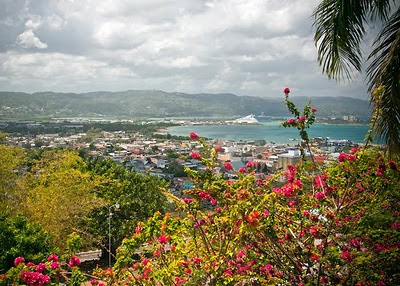
I'd like to return to Jamaica some day, but probably not for quite a few years. I'd like to hope that the passage of time will help the island regain its footing and lift itself out of the crushing poverty it's fallen into, but I have no great confidence in this. Tourism alone can't rescue the country, and there's little industry otherwise that can boost it from within. Still, in any place with this much natural beauty, there's always hope.
For more photos from our Jamaica trip, visit the gallery at Lisa On Location.
Now Playing: Ladysmith Black Mambazo Ladysmith Black Mambazo
Chicken Ranch Central
You remember Jamaica, the tropical tourist paradise of the 1980's "Make it Jamaica" television ad campaign. That Jamaica is sadly long gone, wiped out in 1989 by Hurricane Gilbert which, in the span of 24 hours, wiped out the island's economy and threw more than half the population out of work. It was a devastating blow from which Jamaica has never recovered. But vestiges remain. Natural beauty abounds, and the people, despite rampant poverty, are a cheerful bunch with great pride in their nation. They have a lot to be proud of.
Having no interest whatsoever in the gated and secure tourist havens on the island, we'd contracted with a local guide named Michael well in advance, in order to see the real Jamaica. Our ship docked in Montego Bay, and armed guards patrolled the gated port of entry, refusing to let us out until our guide had been located and identified on the other side. This was our first clue that Jamaica wasn't as tourist-friendly has it once had been. The second clue came on the other side of the security perimeter--an extensive, tourist shopping village, filled with modern, hexagonal shops and large glass windows sat utterly abandoned. We're talking acres of market space, laid out as a grand outdoor mall that must've been busting at the seams with vendors and tourists shopping to their hearts' content 25 years ago. Today, the only people there are random taxi drivers looking for a quick fare and a woman calling herself "Eyelash" who offers to braid anyone's hair in cornrows for $20. It seems to me that the shopping center could be revived by pushing back the security fence 50 yards or so, but what do I know?
We drove through the city of Montego Bay into the smaller, hillside community of Tucker. "Nobody goes hungry in Jamaica," explained Michael, and I am inclined to believe him. Pretty much every tree and bush we passed along the road produced some type of fruit, coming into season at different times of the year so that there is always some of nature's bounty available for those to eat who don't have anything else. Appropriately enough, our first stop was a tiny hillside farm on the outskirts of Tucker, where the farmer grew all manner of tropical fruit (along with chickens and rabbits) for his own consumption, with the remainder sold to neighbors. The economy is a small, local scale one, and the farmer (whose name I've sadly forgotten) laughed when I asked if he sold his produce at a market.
If there is a tropical fruit that exists, this man most likely had it growing somewhere on his few acres clinging to the edge of the hill. There were several types of bananas (including the ubiquitous plantain and also super-sweet honey bananas), star fruit, bread fruit, coconut palms, pineapples, avocados, squash, tomatoes, cacoa trees, coffee trees, sugar cane, prickly pear, sour oranges and a smallish, super-sweet varietal of orange he assured us is only grown on Jamaica.
One of the most interesting fruits he had for us to sample was the apple-sized, green-skinned ball in the image above. It had a thick rind, not entirely unlike an orange, but it was very smooth. Inside, the pulp was ivory colored and creamy in texture, with semi-large black seeds in the core. The the creamy pulp was mild in flavor, tasting of mild banana and vanilla. "Custard-like" is over-used, but that's the best description for this. Between the farmer's thick accent and other fruits he shared with us, I missed the name. Online searches have proven frustrating as well. I've narrowed it down to either a Jamaican soursop or custard apple, but descriptions and images don't perfectly match up with either. If you ever get the chance to try one, however, I highly recommend it.
The other big surprise waiting for me came when the farmer whipped out his trusty machete. On Jamaican farms, the machete is the equivalent of a Swiss Army knife--it's used for everything. He gathered several orange-hulled coconuts and hacked the ends off, so that there was an opening for a straw in the side. Then the coconuts were distributed for us to drink from. Now, folks who know me know that I can't stand coconut. The texture and flavor are utterly repulsive. The scent is tolerable, but to put it plain and simple, I don't like the stuff. Yet this humble farmer was sharing some of his valuable crop with me, and it would be shameful on my part to decline. So I took a sip. Friends and neighbors, Robert Mitchum probably said it best with his song "Coconut Water". This stuff tasted nothing like any coconut I've ever had. The unripe, young coconut had a mild, slightly sweet juice inside that tasted wonderful. It didn't taste at all like coconut. It didn't taste like vanilla, but it had that same sort of subtle flavor profile. And the jelly! The immature coconut meat had a gelatin-like texture we used shards of husk to scrape out once the water had been consumed, and the jelly had that same, wonderful flavor. If this stuff were readily available in Texas, I'd definitely become a regular fan.
Remember how I said earlier that nobody goes hungry in Jamaica? Well, nobody goes without flowers, either. Everything bloomed here, usually with spectacular results. There were more beautiful flowers per square yard here than I've ever seen before, and most of them I had no clue as to what they were. There were quite a few Pride of Barbados, but most, like the wonderful crimson raceme above, are a beautiful mystery.
That beauty doesn't hide the poverty, however. The majority of the population around Montego Bay live in humble accommodations, to say the least. Very few homes have running water, with bathing and washing done in the rivers and streams. Houses are simple affairs, often constructed by squatters on any spot of available land, and many cling precariously to the hillside. We drove past a dump, and many shacks constructed from debris scavenged from there. One thing that really stood out, however, is the apparent pride Jamaicans take in even these simple buildings. A surprising number of them had these impressive covered patio entrances, framed by Greek columns. This grandiose feature was incongruous considering the ramshackle nature of the rest of the houses, but was a very common building trend.
Another common trend was the bright, tropical colors the houses were painted. Bright, joyous colors were the order of the day--at least for those homes that had reached a general state of completion. More often than not the houses were only partially finished, raw cinder block walls and sheet metal roofing seen more often than not. Michael explained that the residents would get a little bit of money and build until the money was exhausted. Then they'd start saving again, until they had enough cash to make more progress. Some homes took years to complete, and houses with incomplete second floors were regular sights.
We toured the colonial-era Hotel Grace, one surviving vestige of Jamaica's more prosperous past. The stately manor occupies one of the highest points in Montego Bay, and commands a spectacular view over the city and harbor. It is now a special events venue, hosting destination weddings and other high-end happenings. My daughter, Fairy Girl, spotted a grand piano and took her cue to play a rousing rendition of Vince Guaraldi's "Linus and Lucy" to the delight of everyone there. It was a special moment for her, one I'm happy to have been a part of.
Afterwards, we drove over to The Pork Pit, our most touristy destination of the day. Frequented by tourists and locals alike, the place had open-pit grills and was evocative of the best old-school barbecue stands in Texas, but here they specialized in jerk pork and jerk chicken. I have to say, they are really, really good at what they do. I had half a pound of jerk pork with rice and beans, and it was spectacular. The hot pepper sauce/relish in the squeeze bottles was phenomenal as well. I could've eaten until I burst. A sobering moment came when Michael (who we'd bought lunch) mentioned that he loved jerk pork but could only afford it on special occasions. Here was our guide, a quick-witted, relative sophisticated business man who made a good living compared to most of his countrymen, not being able to afford his culture's signature meal. That was a poignant reminder of how precarious the Jamaican economy is for all but the most wealthy of Jamaicans.
By far, the majority of Jamaicans we saw scratched out a living similar to this newspaper vendor, who sold papers in the middle of the highway during rush hour. Traffic is chaotic in Montego Bay, resembling a Shriners' parade go-cart scramble. And there was no median for the vendors to stand on, so they made their way through the traffic. In addition to newspapers, we saw others hawking fruit, soft drinks, and in at least one case, Red Stripe Beer to the passing motorists.
The streets of Montego Bay itself were constantly crowded. Peddlers sold all manner of items on the sidewalks as foot traffic pushed by. There was much litter everywhere. It was noisy and raucous, but most people seemed happy from my limited vantage point. Our guide pointed out tourists walking down the sidewalk (there were very easy to spot, I assure you) and then pointed out their guide, explaining they'd have been robbed by now were they not with a knowledgeable guide. I was not inclined to disbelieve him, and for most of the trip The Wife and I tried to keep our Canon cameras out of sight--or at least inconspicuous--as possible.
We wrapped up the day at Dump-Up Beach, a gated beach park frequented by locals and tourists alike. Music played from loudspeakers, and locals would break into impromptu reggae song at the slightest provocation. Most of the tourists were American college students on spring break (although there were some Brits as well) and these students were more often drunk than not. Several of the local men took the opportunity to chat up the American co-eds, and the co-eds didn't seem to mind. Still, the beach was well-kept and quiet. The sand was white and clean, and the water crystal clear and amazingly still, making it easy to catch glimpses of fish beneath the surface. Across the bay we could see our ship docked, and the troubles of the world seemed a million miles away. During our afternoon of driving around Montego Bay, we passed high-walled resorts for Sandals and other hotel chains. The people holed up in there were missing everything that made Jamaica unique. My children experienced another culture, and saw first-hand how hard life is for many people elsewhere in the world. I hope it gives them a better appreciation for the many luxuries and advantages they enjoy.
I'd like to return to Jamaica some day, but probably not for quite a few years. I'd like to hope that the passage of time will help the island regain its footing and lift itself out of the crushing poverty it's fallen into, but I have no great confidence in this. Tourism alone can't rescue the country, and there's little industry otherwise that can boost it from within. Still, in any place with this much natural beauty, there's always hope.
For more photos from our Jamaica trip, visit the gallery at Lisa On Location.
Now Playing: Ladysmith Black Mambazo Ladysmith Black Mambazo
Chicken Ranch Central
Friday, March 25, 2011
Friday Night Videos
Greetings from Jamaica! Or Grand Cayman! Or somewhere else out in the Gulf of Mexico! I don't really know where I am right now, but I'm probably having a better time than you right at this minute. There's a generous amount of rum involved, I can assure you, so today's Friday Night Video has a bit of tropical flair, Blondie's "The Tide Is High." It's an entertaining song, breaking the band out of its comfort zone, but honestly, has there ever been a more wretched music video? I wonder how much of that wretchedness has to do with Debbie Harry's vacant, glassy-eyed stare? She may well have taken herself a trip to Jamaica, but odds are she didn't restrict her intake to rum.
Previously on Friday Night Videos... Syd Barrett.
Now Playing: Herb Alpert & the Tijuana Brass Whipped Cream and Other Delights
Chicken Ranch Central
Previously on Friday Night Videos... Syd Barrett.
Now Playing: Herb Alpert & the Tijuana Brass Whipped Cream and Other Delights
Chicken Ranch Central
Friday, March 18, 2011
Friday Night Videos
Pink Floyd's one of my favorite bands, and I even got to see the band live in the Alamodome during the Division Bell tour. But for anyone who knows them solely for Dark Side of the Moon or The Wall, there is a whole other Pink Floyd that's pretty much as far removed from the Roger Waters/David Gilmour concept albums as possible. Band founder Syd Barrett was a songwriter of unparalleled whimsy, embracing psychedelia whole-heartedly, with the aid of many, many illegal drugs. This ultimately destroyed his mind and led to his replacement in the band by Gilmour, but not before he'd produced several quirky albums with Pink Floyd and a like number of his own. His solo work often suffers from shoddy production values, but his songs are invariably catchy, bizarre and ultimately addictive. Here's one of Syd's better-known singles, "Gigolo Aunt." Enjoy!
Previously on Friday Night Videos... R.E.M..
Now Playing: Pink Floyd Atom Heart Mother
Chicken Ranch Central
Previously on Friday Night Videos... R.E.M..
Now Playing: Pink Floyd Atom Heart Mother
Chicken Ranch Central
Tuesday, March 15, 2011
Spring is here! Oh, spring is here!
...Life is skittles and life is beer.
Okay, enough Tom Lehrer. I've been obsessing over spring gardening since February with my grafting and other such inane chatter, so I figure instead of words it is time to share photographic mayhem of the growth unfolding in my back yard. First up is one of the pear grafts, which is not only still alive, but flowering like there's no tomorrow. This particular graft is what I believe to be a Garber pear:
This other graft is not flowering, but it is leafing out quite nicely. This is the second type of pear graft from early February, and unfortunately I have no clue as to what type of pear this might be. I'm guessing on no evidence at all that it may be a Kieffer, simply because the old tree I took it from is ancient, gnarled and half-dead, so it may be one of those 100-year-old homestead pears you hear about on occasion. This summer I'll be sure to try and examine the fruit to see if I can get a better I.D.
Elsewhere, not quite so dramatic as the grafts but no less significant is the bud break of my Fredonia grape vines. Grape vines always look dead until they burst forth with their rose-and-green leaves in the spring. A few months from now, they'll be sporting bunches of purple-black grapes.
And my passion vines return! All over the yard, the crisp green shoots are emerging from winter dormancy. Incarnata produces lovely, fragrant flowers and delicious fruit. My over-large Texas native is still growing strong, but there are also seedling offspring, crossed with the smaller, more traditional incarnata I have growing elsewhere. These wonderful plants spread aggressively, but in the wild they seem much more subdued and restricted in their range.
Fairy Girl's La Feliciana peach is blossoming as well. It only made one peach last season, although to be fair, that was only its second year in the ground. With the cold winter we had, there's potential for a lot more this year.
These are the muscadines I have growing over the dog run fence a short way down from the Fredonia grapes. Muscadines don't like to root from cuttings, so layering in soil to force root growth is the best way to propagate this type of native grape vine. I've found that 16-20 oz. plastic soda bottles work very well for this. The muscadines don't like my heavy clay soil much, but I add sulphur to bring down the PH and with a little boost of nitrogen they'll produce nice, fat clusters of nutty tasting slip skin grapes.
My fig is leafing out as well, and if you look closely to the left of the stem, you'll see one of the first early crop figs forming already. I've got no idea what type of fig this is--it's an open eye type that spoils quickly once it ripens--but it's mildly sweet and decent enough to eat when fresh. With luck I'll be able to trade for some budwood over the winter and graft some improved varieties onto this one.
That's pretty much it for the back yard, with the exception of some dewberry vines around the side of the house (they took root by accident and don't quite get enough sunlight to produce well). What do you have growing at your place?
Now Playing: John Williams Star Wars Episode I: The Phantom Menace
Chicken Ranch Central
Okay, enough Tom Lehrer. I've been obsessing over spring gardening since February with my grafting and other such inane chatter, so I figure instead of words it is time to share photographic mayhem of the growth unfolding in my back yard. First up is one of the pear grafts, which is not only still alive, but flowering like there's no tomorrow. This particular graft is what I believe to be a Garber pear:
This other graft is not flowering, but it is leafing out quite nicely. This is the second type of pear graft from early February, and unfortunately I have no clue as to what type of pear this might be. I'm guessing on no evidence at all that it may be a Kieffer, simply because the old tree I took it from is ancient, gnarled and half-dead, so it may be one of those 100-year-old homestead pears you hear about on occasion. This summer I'll be sure to try and examine the fruit to see if I can get a better I.D.
Elsewhere, not quite so dramatic as the grafts but no less significant is the bud break of my Fredonia grape vines. Grape vines always look dead until they burst forth with their rose-and-green leaves in the spring. A few months from now, they'll be sporting bunches of purple-black grapes.
And my passion vines return! All over the yard, the crisp green shoots are emerging from winter dormancy. Incarnata produces lovely, fragrant flowers and delicious fruit. My over-large Texas native is still growing strong, but there are also seedling offspring, crossed with the smaller, more traditional incarnata I have growing elsewhere. These wonderful plants spread aggressively, but in the wild they seem much more subdued and restricted in their range.
Fairy Girl's La Feliciana peach is blossoming as well. It only made one peach last season, although to be fair, that was only its second year in the ground. With the cold winter we had, there's potential for a lot more this year.
These are the muscadines I have growing over the dog run fence a short way down from the Fredonia grapes. Muscadines don't like to root from cuttings, so layering in soil to force root growth is the best way to propagate this type of native grape vine. I've found that 16-20 oz. plastic soda bottles work very well for this. The muscadines don't like my heavy clay soil much, but I add sulphur to bring down the PH and with a little boost of nitrogen they'll produce nice, fat clusters of nutty tasting slip skin grapes.
My fig is leafing out as well, and if you look closely to the left of the stem, you'll see one of the first early crop figs forming already. I've got no idea what type of fig this is--it's an open eye type that spoils quickly once it ripens--but it's mildly sweet and decent enough to eat when fresh. With luck I'll be able to trade for some budwood over the winter and graft some improved varieties onto this one.
That's pretty much it for the back yard, with the exception of some dewberry vines around the side of the house (they took root by accident and don't quite get enough sunlight to produce well). What do you have growing at your place?
Now Playing: John Williams Star Wars Episode I: The Phantom Menace
Chicken Ranch Central
Sunday, March 13, 2011
The root of the problem
The school funding shortfall is not Governor Perry's fault, and he's not to blame for the thousands of teachers facing unemployment, nor for the degraded state of education in Texas. Yeah, right. From today's San Antonio Express-News:
Now Playing:
Chicken Ranch Central
The economic recession has contributed to sagging state revenue, although the problems took root in May 2006 when the Legislature cut school property taxes in response to a Texas Supreme Court order to fix an unconstitutional funding system.A liar's one thing. But a liar that won't man up and own his own lies is lower than the slime on a channel cat's belly.
Perry and other state leaders promoted a revised business tax to help pay for the school property tax cuts.
The non-partisan Legislative Budget Board and Carole Keeton Strayhorn, then the state comptroller, predicted the swap would create a revenue shortfall of at least $23 billion over five years. Perry dismissed the warnings, arguing that property tax cuts would ignite economic growth that Strayhorn and the LBB had ignored in their calculations.
This year, John Heleman, chief revenue estimator for Comptroller Susan Combs, told lawmakers a $5 billion-per-year budget shortfall would continue to repeat itself in future years unless they adjusted revenue and expenses.
Now Playing:
Chicken Ranch Central
Saturday, March 12, 2011
Save Texas Schools!
Why should Wisconsin have all the fun? Texas isn't known for its protest rallies. Folks around here generally aren't the radical types--even back in the days when the state was Yellow Dog Democrat, the population tended to have a conservative, don't-rock-the-boat outlook on society. So if you can get 10,000 Texans of all political stripe to turn out for a cause on a Saturday afternoon that doesn't involve high school or college football, well friends and neighbors, you know something's up.
The Wife and I packed up the kids this morning and made the trip up to Austin to participate in the Save Texas Schools rally. In case you've been living under a rock, Governor Rick Perry, in his infinite wisdom, has proposed a budget that cuts $10 billion from public education (and this doesn't even count the cuts to higher education, which is another issue entirely), which will result in nearly one third of teachers in Texas being laid off, and class rooms going from 22 students per to 40-50(!). The reason for these staggering cuts are simple: Texas schools are funded almost entirely by property taxes, and in 2006, Perry pushed through massive property tax cuts. Trouble is, he neglected to adequately compensate for those cuts with alternate funding sources, so Texas schools are facing a catastrophe of Perry's creation, and our dear governor is disavowing any responsibility. He's refusing to consider any new revenue sources, any new taxes, or tapping the state's $9 billion "Rainy Day Fund" to plug the shortfall until legislators can come up with a solution.
Fed up with Perry's stubborn refusal to deal with the problem in a constructive manner, not to mention the legislature's dithering, we--along with 10,000 of our closest friends--trekked to Austin for a march and rally to let our displeasure be known. What follows are some of the interesting photos The Wife shot during the day. This is only a small sample of them, though--check out her Save Our Schools photo gallery for more (there's some great stuff there, you really should check it out).
My contempt for Gov. Perry is well-documented. I was gratified to see that my feelings are shared by many. Of course, with any big rally, the signs are the most entertaining part. Texans are no less creative at this than others, and Lone Star pride was a running theme. Probably the most pervasive image was an updating of the famous "Come and Take It" flag, substituting a no. 2 classroom pencil for the original brass cannon.
It didn't take long for the ubiquitous Charlie Sheen reference to make its way through the crowd, leaving a trail of laughter in its wake.
On thing I've seen online that troubles me is a dismissal of the rally, and by extension, all "Save Texas Schools" activity, as nothing more than greedy teachers union agitation. Why is this troubling? Because there are no teachers unions in Texas. At least not by any substantive measure. Texas is a right-to-work state, meaning unions here--as throughout the south--are impotent and mostly irrelevant. There is no collective bargaining, so Texas school funding deficit can't be blamed on any convenient union scapegoat (that's not to say certain parties haven't tried, though).
I've recently endured some unpleasant insults--both oblique and direct--regarding my stand on public schools in Texas. That public schools are a waste of money, home schooling and private schools are better, and public school teachers are essentially worthless. I tend to react strongly to this. I come from a teacher family. My father taught high school for 22 years, and after that served on the school board for the better part of a decade. For all his faults, he was dedicated to teaching. He educated students who didn't cotton to no learnin' and went out of his way to help out the less fortunate, giving summer jobs to the less fortunate and always managing to "accidentally" over-pay them while boosting their sense of self-worth. My wife comes from a teaching family, too, and my father-in-law was as passionate about science in the classroom as he was about giving his best to the track team he coached although they were hampered by woefully inadequate facilities. He then spent years working as an assistant principal, trying to ensure a solid education for all while dealing with transfers into his school of students who'd departed Austin ISD because of "discipline problems" who had no interest in education of any sort.
We have friends who are teachers--pretty much every teach who has ever had our children in class, going out of their way to engage and stimulate our daughters, giving them personal attention when they need it most. These same teachers thank us profusely when we send an extra box of tissue to school, since they're out in the classroom during cold season and there's no money in the budget to buy any more. Teacher who pay out of pocket for books to stock the classroom library, because, again, there's no money otherwise. Teachers don't go into teaching because of the glory, or the massive paychecks, or the cush working conditions. Teaching is a calling. That's something legislators and anti-public schooling types don't seem to grasp. So is it any wonder I take it personally when public school teachers are denigrated, and respond--forcefully--in kind? This is my stand, and I make no apologies for it.
There was a time, no too long ago, when Texas Republicans and Democrats generally agreed on the importance of public education. That a strong public education system was the most valuable public good in the state, that and educated population meant a valuable population, attracting well-paying jobs and elevating business, the economy and ultimately social services. Somehow, somewhere, this went off the rails. Texas now ranks around 36th nationally for education spending per student, a ranking that would fall to 50th out of 50 states if Perry's budget plan passes. Texas students currently rank around 42nd nationally in the classroom, which prompts jokes about the Arkansas and Mississippi state legislatures passing resolutions that "Thank God for Texas!"
As I said earlier, around 10,000 people from across the state turned out for the rally. The kick-off march stretched seven blocks. There were buses everywhere. There were people from Houston, Austin, San Antonio, Fort Worth. One bunch drove all the way in from El Paso. There were teachers, parents, children, college students, grandparents, black, white, Hispanic... it was as pure a sampling of Texas' demographic as anyone could want. Everyone coming together for one purpose, to keep short-sighted politics from devastating Texas education for years to come.
Earlier this week, Perry dismissed the coming rally, saying (with disingenuous flair), "The lieutenant governor, the speaker and their colleagues aren’t going to hire or fire one teacher, as best I can tell. That is a local decision that will be made at the local districts." That smarmy, condescending comment immediately brought to mind Pontius Pilate famously washing his hands. A little melodramatic, of course, but the imagery is vivid nonetheless.
Umbrellas were out in full force, symbolizing the demand that the legislature tap the state's $9 billion rainy day fund. Were the great Stevie Ray Vaughan still alive, he'd surely be singing "It's Flooding Down in Texas." What wasn't out in force was the Tea Party types. Online chatter had them staging a counter-rally to praise Perry for his hard line against, well, I suppose teachers and those darn pesky student who want to learn. Although The Wife and I looked for them, we never saw any. We saw a few "Don't Tread on Me" flags, but these were usually paired with "Come and Take It" flags, so I don't think they counted.
All in all, it was inspiring to see so many Texans, from all walks of life, turn out to show they care about education. The United States is great because of education--the G.I. Bill following World War II produced the single most educated population in history, an advantage that took 60 years for the rest of the world to catch up to. Home schooling works for some, private school for others, but as a state, as a nation, these are not solutions that will render us competitive on a global state. Public education is the key to the future success of America, and we've got to strengthen our schools and reverse the appalling dropout rates rather than eviscerate the education budget and vilify our teachers. I'm teaching my children the value of education, and how to be a part of the solution, not part of the problem. The rally today was a tiny step in that direction.
Let me close with a portion of Perrin-Whitt CISD Superintendent John Kuhn's amazing speech on the importance of public education. Kuhn is he of the eloquent open letter on behalf of all public education, which should stir the heart of any true Texas.
Where's Sam Houston when you need him?
Now Playing: Pink Floyd The Wall
Chicken Ranch Central
The Wife and I packed up the kids this morning and made the trip up to Austin to participate in the Save Texas Schools rally. In case you've been living under a rock, Governor Rick Perry, in his infinite wisdom, has proposed a budget that cuts $10 billion from public education (and this doesn't even count the cuts to higher education, which is another issue entirely), which will result in nearly one third of teachers in Texas being laid off, and class rooms going from 22 students per to 40-50(!). The reason for these staggering cuts are simple: Texas schools are funded almost entirely by property taxes, and in 2006, Perry pushed through massive property tax cuts. Trouble is, he neglected to adequately compensate for those cuts with alternate funding sources, so Texas schools are facing a catastrophe of Perry's creation, and our dear governor is disavowing any responsibility. He's refusing to consider any new revenue sources, any new taxes, or tapping the state's $9 billion "Rainy Day Fund" to plug the shortfall until legislators can come up with a solution.
Fed up with Perry's stubborn refusal to deal with the problem in a constructive manner, not to mention the legislature's dithering, we--along with 10,000 of our closest friends--trekked to Austin for a march and rally to let our displeasure be known. What follows are some of the interesting photos The Wife shot during the day. This is only a small sample of them, though--check out her Save Our Schools photo gallery for more (there's some great stuff there, you really should check it out).
My contempt for Gov. Perry is well-documented. I was gratified to see that my feelings are shared by many. Of course, with any big rally, the signs are the most entertaining part. Texans are no less creative at this than others, and Lone Star pride was a running theme. Probably the most pervasive image was an updating of the famous "Come and Take It" flag, substituting a no. 2 classroom pencil for the original brass cannon.
It didn't take long for the ubiquitous Charlie Sheen reference to make its way through the crowd, leaving a trail of laughter in its wake.
On thing I've seen online that troubles me is a dismissal of the rally, and by extension, all "Save Texas Schools" activity, as nothing more than greedy teachers union agitation. Why is this troubling? Because there are no teachers unions in Texas. At least not by any substantive measure. Texas is a right-to-work state, meaning unions here--as throughout the south--are impotent and mostly irrelevant. There is no collective bargaining, so Texas school funding deficit can't be blamed on any convenient union scapegoat (that's not to say certain parties haven't tried, though).
I've recently endured some unpleasant insults--both oblique and direct--regarding my stand on public schools in Texas. That public schools are a waste of money, home schooling and private schools are better, and public school teachers are essentially worthless. I tend to react strongly to this. I come from a teacher family. My father taught high school for 22 years, and after that served on the school board for the better part of a decade. For all his faults, he was dedicated to teaching. He educated students who didn't cotton to no learnin' and went out of his way to help out the less fortunate, giving summer jobs to the less fortunate and always managing to "accidentally" over-pay them while boosting their sense of self-worth. My wife comes from a teaching family, too, and my father-in-law was as passionate about science in the classroom as he was about giving his best to the track team he coached although they were hampered by woefully inadequate facilities. He then spent years working as an assistant principal, trying to ensure a solid education for all while dealing with transfers into his school of students who'd departed Austin ISD because of "discipline problems" who had no interest in education of any sort.
We have friends who are teachers--pretty much every teach who has ever had our children in class, going out of their way to engage and stimulate our daughters, giving them personal attention when they need it most. These same teachers thank us profusely when we send an extra box of tissue to school, since they're out in the classroom during cold season and there's no money in the budget to buy any more. Teacher who pay out of pocket for books to stock the classroom library, because, again, there's no money otherwise. Teachers don't go into teaching because of the glory, or the massive paychecks, or the cush working conditions. Teaching is a calling. That's something legislators and anti-public schooling types don't seem to grasp. So is it any wonder I take it personally when public school teachers are denigrated, and respond--forcefully--in kind? This is my stand, and I make no apologies for it.
There was a time, no too long ago, when Texas Republicans and Democrats generally agreed on the importance of public education. That a strong public education system was the most valuable public good in the state, that and educated population meant a valuable population, attracting well-paying jobs and elevating business, the economy and ultimately social services. Somehow, somewhere, this went off the rails. Texas now ranks around 36th nationally for education spending per student, a ranking that would fall to 50th out of 50 states if Perry's budget plan passes. Texas students currently rank around 42nd nationally in the classroom, which prompts jokes about the Arkansas and Mississippi state legislatures passing resolutions that "Thank God for Texas!"
As I said earlier, around 10,000 people from across the state turned out for the rally. The kick-off march stretched seven blocks. There were buses everywhere. There were people from Houston, Austin, San Antonio, Fort Worth. One bunch drove all the way in from El Paso. There were teachers, parents, children, college students, grandparents, black, white, Hispanic... it was as pure a sampling of Texas' demographic as anyone could want. Everyone coming together for one purpose, to keep short-sighted politics from devastating Texas education for years to come.
Earlier this week, Perry dismissed the coming rally, saying (with disingenuous flair), "The lieutenant governor, the speaker and their colleagues aren’t going to hire or fire one teacher, as best I can tell. That is a local decision that will be made at the local districts." That smarmy, condescending comment immediately brought to mind Pontius Pilate famously washing his hands. A little melodramatic, of course, but the imagery is vivid nonetheless.
Umbrellas were out in full force, symbolizing the demand that the legislature tap the state's $9 billion rainy day fund. Were the great Stevie Ray Vaughan still alive, he'd surely be singing "It's Flooding Down in Texas." What wasn't out in force was the Tea Party types. Online chatter had them staging a counter-rally to praise Perry for his hard line against, well, I suppose teachers and those darn pesky student who want to learn. Although The Wife and I looked for them, we never saw any. We saw a few "Don't Tread on Me" flags, but these were usually paired with "Come and Take It" flags, so I don't think they counted.
All in all, it was inspiring to see so many Texans, from all walks of life, turn out to show they care about education. The United States is great because of education--the G.I. Bill following World War II produced the single most educated population in history, an advantage that took 60 years for the rest of the world to catch up to. Home schooling works for some, private school for others, but as a state, as a nation, these are not solutions that will render us competitive on a global state. Public education is the key to the future success of America, and we've got to strengthen our schools and reverse the appalling dropout rates rather than eviscerate the education budget and vilify our teachers. I'm teaching my children the value of education, and how to be a part of the solution, not part of the problem. The rally today was a tiny step in that direction.
THE TEXAS CONSTITUTION
ARTICLE 7. EDUCATION
Sec. 1. SUPPORT AND MAINTENANCE OF SYSTEM OF PUBLIC FREE SCHOOLS. A general diffusion of knowledge being essential to the preservation of the liberties and rights of the people, it shall be the duty of the Legislature of the State to establish and make suitable provision for the support and maintenance of an efficient system of public free schools.
Let me close with a portion of Perrin-Whitt CISD Superintendent John Kuhn's amazing speech on the importance of public education. Kuhn is he of the eloquent open letter on behalf of all public education, which should stir the heart of any true Texas.
Where's Sam Houston when you need him?
Now Playing: Pink Floyd The Wall
Chicken Ranch Central
Subscribe to:
Posts (Atom)


