So USC goes and chokes when they had two chances to put the game away. First, needing two yards for a first down--which would enable them to run out the clock and thus win the game--they opt to run the ball up the middle, a middle which was stacked with Longhorn defenders expecting USC to do just that. The runner is stopped short, ball goes over on downs. Then, with 30 seconds left in the game and the 'sips facing their own fourth down try in the shadow of the goalposts, the Trojans inexplicably neglect to put any containment on Vince Young. Un. Frelling. Believable. At the end of the game, when it mattered, USC looked nothing like the two-time defending national champs that had won 34 straight. Sigh.
The worst part of this deal isn't all the ugly roadside kiosks selling even uglier burnt orange clothing that are popping up across the state like mushrooms (although that's bad). It's not even all the t-sips like Bill Crider that will strut and prance around in celebration like Mick Jagger on parade (although that's bad, too. Especially if you've ever seen Crider prance). No, the absolute worst aspect of a t-sip national championship is the fact that thousands upon thousands of bandwagon fans who've never, ever so much as set foot on that Austin campus will take it upon themselves to get in the face of anyone not on said bandwagon and offer such intellectually stimulating conversation starters as "We kicked your ASS!" and "Aggies suuuuuuuck!" Although, to be fair, that last one isn't reserved specifically for A&M grads. Depending on the situation, the clever 'sip wannabe can substitute Trojans/Sooners/Buffaloes/Cornhuskers with little or no advance planning. They're clever that way.
And yes, if you're wondering, I am wearing black today.
Now Playing: Johnny Cash American IV: The Man Comes Around

Thursday, January 05, 2006

Wednesday, January 04, 2006
Of maps and tiaras
I've already talked about Pope Saint Gregory the Great's Reliquary as well as a couple of chalices that made an impression on me, but I want to point out two more items I found interesting at the "Saint Peter and the Vatican: The Legacy of the Popes" exhibition I visited last week:
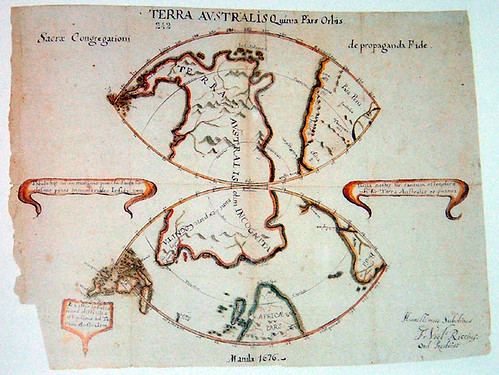
"Terra Australis Quinta Pars Orbis" dates from 1676, and is the oldest known map of Australia. Pretty cool, huh? Not something you'd expect from the Vatican archives. It was drawn by Vittorio Ricci, a Dominican missionary who was conducted a number of missions into China. He never actually visited Austraila, apparently, but based the map on accounts he took from captive natives (ie slaves) and Dutch traders/explorers/slavers while based in Manila, in the Phillipines. Ricci's goal was to convince Rome that Manila was the best location from which to launch a mission to the unexplored southern continent.
And, lest I fall short of the bejewelled quotient required of all writings regarding Vatican treasures, I offer the famous tiara of Pope Pius VII:
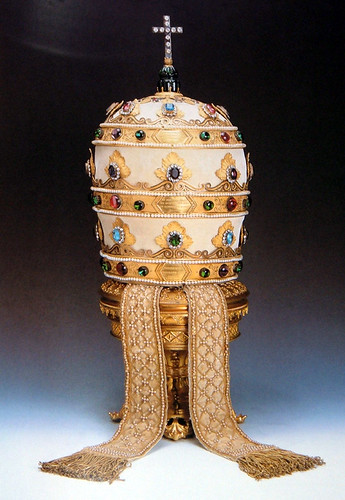
A gift from Napoleon Bonaparte to Pope Pius VII in 1805, the irony is that the tiara was made of treasure looted from the Vatican eight years before when French troops invaded the Papal States. Ostensibly, the gift was a gesture of atonement from Napoleon for the plunder nearly a decade earlier, but the base was so small Pius VII could not wear it--an intentional slight by Napoleon. Most of the original jewels adorning the tiara were replaced with cut glass during the 19th century, but the huge milled emerald supporting the diamond-studded cross at the top--the Emerald of Gregory XIII--remains (and had actually been mounted on several different tiaras used by Pius VII's predecessors). Also stripped from the tiara were three engraved bas-reliefs that depicted scenes of Napoleon's coronation as Emperor of France, re-legalization of public worship in France and the signing of a treaty between the Vatican and France. I think it's safe to say that even without the original jewels and engravings, this is still and overwhelmingly opulent piece. Even if nobody ever got to wear it.
Now Playing: Pandora Stan Getz and Joao Gilberto radio
"Terra Australis Quinta Pars Orbis" dates from 1676, and is the oldest known map of Australia. Pretty cool, huh? Not something you'd expect from the Vatican archives. It was drawn by Vittorio Ricci, a Dominican missionary who was conducted a number of missions into China. He never actually visited Austraila, apparently, but based the map on accounts he took from captive natives (ie slaves) and Dutch traders/explorers/slavers while based in Manila, in the Phillipines. Ricci's goal was to convince Rome that Manila was the best location from which to launch a mission to the unexplored southern continent.
And, lest I fall short of the bejewelled quotient required of all writings regarding Vatican treasures, I offer the famous tiara of Pope Pius VII:
A gift from Napoleon Bonaparte to Pope Pius VII in 1805, the irony is that the tiara was made of treasure looted from the Vatican eight years before when French troops invaded the Papal States. Ostensibly, the gift was a gesture of atonement from Napoleon for the plunder nearly a decade earlier, but the base was so small Pius VII could not wear it--an intentional slight by Napoleon. Most of the original jewels adorning the tiara were replaced with cut glass during the 19th century, but the huge milled emerald supporting the diamond-studded cross at the top--the Emerald of Gregory XIII--remains (and had actually been mounted on several different tiaras used by Pius VII's predecessors). Also stripped from the tiara were three engraved bas-reliefs that depicted scenes of Napoleon's coronation as Emperor of France, re-legalization of public worship in France and the signing of a treaty between the Vatican and France. I think it's safe to say that even without the original jewels and engravings, this is still and overwhelmingly opulent piece. Even if nobody ever got to wear it.
Now Playing: Pandora Stan Getz and Joao Gilberto radio
Tuesday, January 03, 2006
Brushfire redux
Okay, I'm back. Immediately after my previous post, I left for home. I could see the cloud of smoke all the way from San Marcos, so I knew the fire was pretty big. This is the view that greeted me when I turned into our subdivision (four emergency response trucks whipped past me as I was turning in, and a New Braunfels Fire Department pumper truck was set up right to the left of this picture):
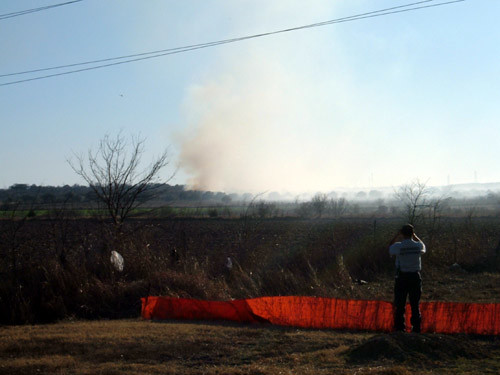
Turns out the fire was set by a moron burning trash--despite the fact there's been a burn ban in effect since before Thanksgiving. Fortunately, the main blaze started about a mile farther back than I initially reported, otherwise it would've reached our homes before I could get there. As it was, there was an emergency evacuation of the subdivision going on when I arrived. I quickly loaded my computer and some clothes into my car, while Lisa gathered photos and negative and the girls grabbed some favorite toys. Then we loaded the dogs and cats--the birds went with a friend of ours--and went to ride out the evacuation at a local McDonald's that had a playland to entertain the girls. We were able to return home about two hours later, once the fire was brought under control. Fortunately, the fire didn't approach much closer than you see above, so our home was never in imminent danger.
Early reports say that 200 acres were burned, which is far less than that which burned here last week, as well as those big ones north of us that wiped out Cross Plains and other small Texas towns in recent weeks. I can tell exactly where the fire burned, and the road to take to get back to where it started. I'm more than a little inclined to drive back there tomorrow, knock on the door of the fool who started the fire, and plant my foot about 18 inches up that moron's ass.
Now Playing: Grateful Dead In the Dark
Turns out the fire was set by a moron burning trash--despite the fact there's been a burn ban in effect since before Thanksgiving. Fortunately, the main blaze started about a mile farther back than I initially reported, otherwise it would've reached our homes before I could get there. As it was, there was an emergency evacuation of the subdivision going on when I arrived. I quickly loaded my computer and some clothes into my car, while Lisa gathered photos and negative and the girls grabbed some favorite toys. Then we loaded the dogs and cats--the birds went with a friend of ours--and went to ride out the evacuation at a local McDonald's that had a playland to entertain the girls. We were able to return home about two hours later, once the fire was brought under control. Fortunately, the fire didn't approach much closer than you see above, so our home was never in imminent danger.
Early reports say that 200 acres were burned, which is far less than that which burned here last week, as well as those big ones north of us that wiped out Cross Plains and other small Texas towns in recent weeks. I can tell exactly where the fire burned, and the road to take to get back to where it started. I'm more than a little inclined to drive back there tomorrow, knock on the door of the fool who started the fire, and plant my foot about 18 inches up that moron's ass.
Now Playing: Grateful Dead In the Dark
Brushfire
Lisa just called. There's a brushfire to the southwest of our subdivision. There's a dry creek bed over that direction, with lots of--wait for it--"tinder-dry" cattails and trees, grass and, yes, brush. The temperature is 83 degrees right now, the humidity is 20 percent, and there are wind gusts from the southwest of 22 mph. Joy. If you want to see what's burning, take a look here. See that pasture and brush land between the Cherokee loop and Doppenschmidt Lane? That's where the smoke and sirens are coming from.
Now Playing: Pandora Stan Getz and Joao Gilberto radio
Now Playing: Pandora Stan Getz and Joao Gilberto radio
Gregory's reliquary
Pope Gregory I, otherwise known as Pope Saint Gregory the Great, is without a doubt one of the most influential popes in the history of the Catholic Church (not to be confused with Pope Gregory XIII, who's name is forever associated with the Gregorian Calendar), but is most widely known to modern society for Gregorian Chants. So it's no surprise that there were a number of displays related to him at the Saint Peter and the Vatican show. But this one really stood out:
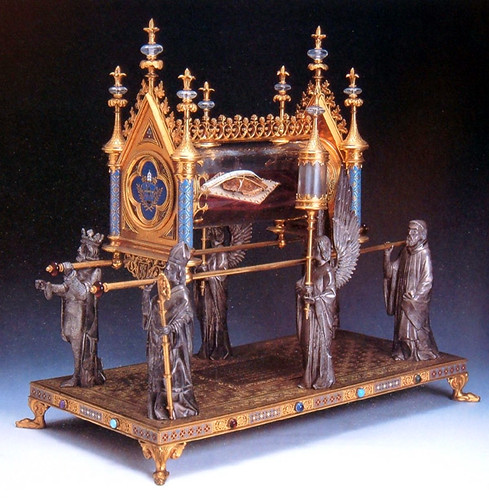
I had no idea what it was when I first happened upon it. It looked like a model of an extravagant funeral procession. Then I read the description, and realized that it was a reliquary. One of the oddest quirks of the church is the fixation on relics of saints--preserved fragments of the body, usually a piece of bone or somesuch. This ancient practice goes a long way toward explaining the Kutna Hora Ossuary. The bone fragment resting within the reliquary on a velvet bed is a skull fragment. The hand of the king at the far left of the image is curled, as if to hold a staff or a sword, but whatever he once held has been lost and the catalog makes no mention of the absent piece. Of particular interest, however, is the fact that the reliquary is composed of colored stones, glass and gilded metal. Despite its treasure-trove appearance, its physical value--as opposed to its historical value--is actually quite modest. I found this more than a little surprising, considering all the solid gold and silver on display elsewhere. Particularly in relation to a saint so revered. Can you tell I find this stuff fascinating?
Now Playing: Pandora Stan Getz & Joao Gilberto radio
I had no idea what it was when I first happened upon it. It looked like a model of an extravagant funeral procession. Then I read the description, and realized that it was a reliquary. One of the oddest quirks of the church is the fixation on relics of saints--preserved fragments of the body, usually a piece of bone or somesuch. This ancient practice goes a long way toward explaining the Kutna Hora Ossuary. The bone fragment resting within the reliquary on a velvet bed is a skull fragment. The hand of the king at the far left of the image is curled, as if to hold a staff or a sword, but whatever he once held has been lost and the catalog makes no mention of the absent piece. Of particular interest, however, is the fact that the reliquary is composed of colored stones, glass and gilded metal. Despite its treasure-trove appearance, its physical value--as opposed to its historical value--is actually quite modest. I found this more than a little surprising, considering all the solid gold and silver on display elsewhere. Particularly in relation to a saint so revered. Can you tell I find this stuff fascinating?
Now Playing: Pandora Stan Getz & Joao Gilberto radio
Monday, January 02, 2006
The dreary depths of winter
It's 82 degrees and sunny today in San Marcos, with only the faintest whisps of cloud in the sky. There's a 15 mile an hour wind blowing from the north and--get this--humidity is 11 percent. It's dry, dry, dry. A grass fire burned a thousand acres and a barn less than a mile from my house last week. A church burned across the street from us on Christmas eve. There's a statewide burn ban in effect because it's hot and dry, dry, dry.
I like to tease my snowbound friends up north that I get to watch the college bowl games in shorts while they're busy shovelling the drive, but come on already. Even for Texas, this weather is ridiculous.
Now Playing: Emerson, Lake and Palmer Return of the Manticore
I like to tease my snowbound friends up north that I get to watch the college bowl games in shorts while they're busy shovelling the drive, but come on already. Even for Texas, this weather is ridiculous.
Now Playing: Emerson, Lake and Palmer Return of the Manticore
Saint Peter and the Vatican
On Friday, for my Christmas present, Lisa sent me in to San Antonio to see Saint Peter and the Vatican: The Legacy of the Popes. I'd been drooling at the prospect of seeing this ever since is was announced way back when. Visiting Rome and Vatican City to take in all the architecture and museums has long been a cherished goal of mine, and this was the next best thing. Since the San Antonio engagement was ending January 8, though, I had resigned myself to missing it. But my dear wife came through, and it was a fantastic experience. Sensory overload, in many ways. The attendance was very high, and it took me three hours to work my way through the entire show. Unfortunately, cameras weren't allowed (protecting some items from the damaging effects of light from the flashes was one reason) but unlike the Lord of the Rings exhibit in Houston, the Vatican show included some very impressive souvenir merchandise, including this massive, 521-page exhibit catalog:
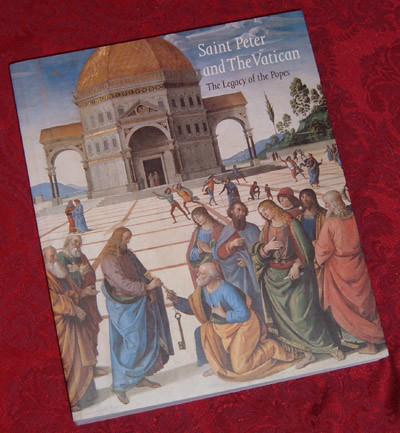
Catalog is something of a misnomer. It's lavishly illustrated, and exhaustive in its nearly encyclopedic discussions of the objects on display--their historical, theological and liturgical context. It's like National Geographic on steroids. It contains answers to all the questions I had during the exhibit, and many more I hadn't even considered.
There were many, many displays that were moving, overwhelming or just plain dazzling. The recreation of the "Street of Tombs" beneath St. Peter's Basilica leading to St. Peter's tomb is interesting in and of itself, but it isn't given context until after the fact, at which point it becomes much more impressive. The well-publicized "Mandylion of Edessa," the oldest-known painting of Christ created sometime between the third and fifth centuries is powerful in its simplicity as well as its age. The life-size mockup of Michaelangelo's workspace atop the Sistine Chapel wasn't as impressive as I'd anticipated for some reason, but it was intriguing in that it showed some of the processes and techinques the master had used to transfer his vision to the frescoes of the ceiling.
Of course, when people think of the Vatican, the first thing that often comes to mind is opulent wealth. And there was bonafied treasure on display, make no mistake. Thanks to the chalice of Pope Pius IX (below, scanned from the catalog above) I now know what "jewel-encrusted" truly means:
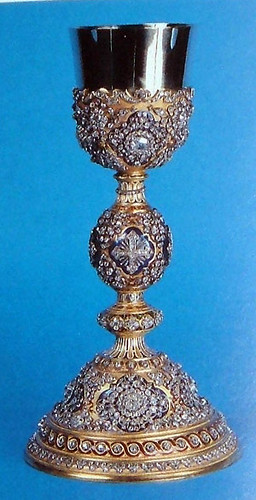
A gift from Sultan Absul Medji to Pope Pius IX in 1846, it is incredibly dazzling in person. Gold with green, blue and red enamel along with a thousand diamonds, it flashes and sparkles like a living thing in even the subdued light of the exhibit space. It is a beautiful and marvelous example of excess. It was used by Pope Benedict XVI during his first mass after election as pope. As overwhelming as that chalice was, it paled in comparison to this one:
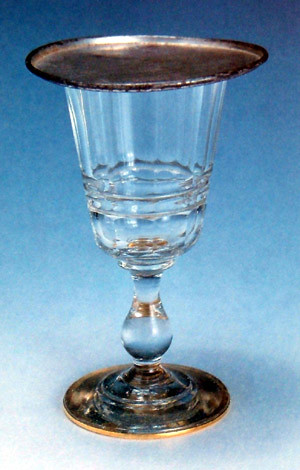
The goblet is simple, plain glass, and the plate atop it is the lid from a tin can. But these simple artifacts were used by priests to celebrate mass while imprisoned in Auschwitz during World War II. After the camp's liberation, the survivors presented them to Pope Paul IV, who gilded the foot of the cup with gold, added an inscription, and placed them in the Treasury of the Papal Sacristy.
The tour began in Montreal last June and after it closes in San Antonio, will wrap up its North American run in Milwaukee from February to May.
Now Playing: Emerson, Lake and Palmer Return of the Manticore
Catalog is something of a misnomer. It's lavishly illustrated, and exhaustive in its nearly encyclopedic discussions of the objects on display--their historical, theological and liturgical context. It's like National Geographic on steroids. It contains answers to all the questions I had during the exhibit, and many more I hadn't even considered.
There were many, many displays that were moving, overwhelming or just plain dazzling. The recreation of the "Street of Tombs" beneath St. Peter's Basilica leading to St. Peter's tomb is interesting in and of itself, but it isn't given context until after the fact, at which point it becomes much more impressive. The well-publicized "Mandylion of Edessa," the oldest-known painting of Christ created sometime between the third and fifth centuries is powerful in its simplicity as well as its age. The life-size mockup of Michaelangelo's workspace atop the Sistine Chapel wasn't as impressive as I'd anticipated for some reason, but it was intriguing in that it showed some of the processes and techinques the master had used to transfer his vision to the frescoes of the ceiling.
Of course, when people think of the Vatican, the first thing that often comes to mind is opulent wealth. And there was bonafied treasure on display, make no mistake. Thanks to the chalice of Pope Pius IX (below, scanned from the catalog above) I now know what "jewel-encrusted" truly means:
A gift from Sultan Absul Medji to Pope Pius IX in 1846, it is incredibly dazzling in person. Gold with green, blue and red enamel along with a thousand diamonds, it flashes and sparkles like a living thing in even the subdued light of the exhibit space. It is a beautiful and marvelous example of excess. It was used by Pope Benedict XVI during his first mass after election as pope. As overwhelming as that chalice was, it paled in comparison to this one:
The goblet is simple, plain glass, and the plate atop it is the lid from a tin can. But these simple artifacts were used by priests to celebrate mass while imprisoned in Auschwitz during World War II. After the camp's liberation, the survivors presented them to Pope Paul IV, who gilded the foot of the cup with gold, added an inscription, and placed them in the Treasury of the Papal Sacristy.
The tour began in Montreal last June and after it closes in San Antonio, will wrap up its North American run in Milwaukee from February to May.
Now Playing: Emerson, Lake and Palmer Return of the Manticore
Subscribe to:
Posts (Atom)