Spring is breaking in Central Texas, and I'm scrambling to keep up with the various plants breaking bud hither and yon. This is not a new experience for me. Consider what I wrote here almost one year ago:
We haven't had much of a winter this year. That's both good and bad. Good, because I absolutely hate the cold. The reason I tolerate the brutality of August in Texas is so that I might wear shorts outdoors in January and February. On the other hand, it's not that great for my fruit trees, which need a certain amount of chill hours annually to produce good crops. That's not a big deal yet, because we've only lived at the new house about 18 months and the trees I planted last year are still too young (for the most part) to bear fruit. Last year we recorded almost 1,000 chill hours, which is a significant amount for this part of Texas, which is more than enough for any of the fruit trees I have growing. This year, even with the mild winter, I'm at 600 chill hours--a decent amount for most of my plants.
This year, I'm sad to say, we're not even at a meagre 300 chill hours--just 293 at last reading--with little hope of gaining any more at this point. That is discouraging, to put it mildly. We had two big freezes this year, and one dropped down to 22F doing significant damage to some of my plants,
despite the fact that I'd covered them and/or added heat lights. Last year we never had any hard freezes, but it stayed chilly for long stretches. Without sufficient chill, fruit trees won't produce.
Most of mine are still too young to worry about that, but if this trend persists through the coming years, it will prove problematic.
What's not problematic are my passion vines. That big flower bud above is from my potted passiflora vitifolia, aka the crimson passion flower. It's already bloomed once in February and has set a bunch more buds. Out in the yard, my passiflora incarnata, aka native maypops, are popping up all over the place after freezing back during the winter. So some plants are happy with the warming trend. Others have a chance to get an early start on the growing season. Below, you'll see the haul I got in from the T.V. Munson vineyard at
Grayson College. For the uninitiated, Munson was a horticulturalist who set up shop in Texas back in the 19th century and bred hundreds of varieties of grapes. He's also credited with saving the French wine industry. Many of the grape varieties he bred used wild stock and are particularly well-suited to growing in Texas, where other domesticated grapes struggle due to climate, disease pressure, etc. Sadly, almost all of Munson's varieties are not available commercially, but the good folks at Grayson sent me cuttings of Elvicand, Ben Hur, Valhallah and Wapanuka. I treated the cuttings with rooting hormone and currently have them warming in moist sphagnum moss to encourage the formation of rooting calluses. In about a month I'll plant them in pots and if all goes well, should have a bunch of vigorous (and rare) grape vines growing by the end of spring.

I also put some effort into propagating the Ison muscadine growing in my back yard. Muscadine grape vines do not easily root from cuttings, so one has to air layer the vines. This involves wounding part of a vine near a bud node, treating the area with rooting hormone (not strictly necessary, but I always do so), and then enclosing the wounded area in a growth medium. In the past I did my air layering using starter pots and tying the vine down... actually, it was pretty labor intensive are my failure rate was high. I saw online this alternative method, which involves cutting the bottom out of a liter bottle and just running the vine straight through, then filling with soil. It certainly is a lot simpler. Time will tell if it is more successful.

Last year, a great deal of my time was spent grafting apple trees. I didn't graft that many this year, but I still did some work in that area. Out front, I have two young Blanco crab apple trees planted. Or rather, did. One abruptly died last fall, and I'm still unclear why it died. To hedge my bets, this year I took some of the pruned branches and grafted them onto the two dwarf apple trees I so vigorously grafted onto last year. You can tell the Blanco crabs aren't domesticated because they've got some serious spurs on the branches.
A few razor cuts later, and the graft is completed. I use cheap electrical tape had have good results. I wrap tightly from the bottom up, then counter-wrap from the top down with a second piece of tape, that way, if the tape starts to unravel (and it does) the top layer has to unravel a
lot before the more important bottom layer can come loose. In the end, I did seven Blanco crab grafts. I also found a branch on my young Arkansas Black apple tree had broken, but was still attached to the tree. I pruned it off and used the good sections of the broken branch to make two more grafts on the dwarf trees. I lost the first Arkansas Black I planted two years ago to drought, so insurance is always good.
This is the simple cleft graft process I use. It's the simplest form of grafting, but I've had excellent success with it. The base of the scion wood is cut into a narrow V, and inserted in a narrow wedge, or cleft, of the tree. Out of the dozens of grafts I made last year, almost 100 percent took. One Hall apple graft started to grow, but abruptly died. Then later, I accidentally broke off a King David graft that was growing vigorously, with no hope of saving it. So, that's a pretty good success rate.
This is what the cleft graft should look like a year from now, when the wound is scarred over and the graft is growing as a solid part of the tree.
The graft union doesn't always grow so neatly. Here's one that's bursting forth through the electrical tape from last year. The tape's not really strong enough to strangle the limb, but it is restrictive. After a year, once the union has properly healed, the tape should be removed.
And this is what it looks like when the tape is peeled away.
I also had two apple salvage jobs left over from last year. I ordered four crab apple trees to go along with the two Blanco crabs out front. Two were Hewe's Virginia crab, and two were Wickon's crab. Alas, the Wickson grafts were DOA, leaving me with only rootstock, and my beagles broke one of the Hewe's, leaving me with just one of the preferred types I'd ordered. Fortunately, the surviving Hewe's put out several branches and I was able to graft parts of them onto the two surviving root stocks. Because these are growing in pots, I was able to get cute and use wax to seal the ends and prevent water loss that way. Not necessary, but always an option.


So, what else is new at the Blaschke homestead for 2017? I'm glad you asked. Whilst I have a couple of paw paw trees, a che and several banana cultivars still in pots waiting on me to prepare their planting areas appropriately, I've managed to put several other new fruiting plants in the ground. The scrubby bush below, in the tomato cage is not new, though. This is a two-year-old goji bush. It struggled the first year in the ground but came on strong last season. I planted another type nearby last year, and it struggled as well. I'm hoping it catches up to its older sibling this year.s
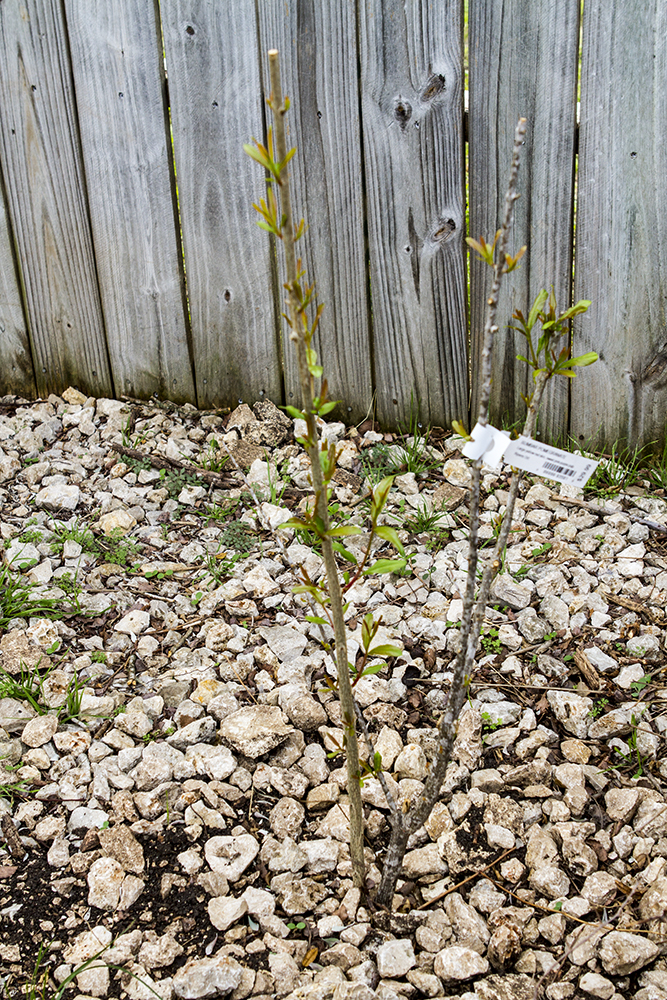
This one is new. It's a "Sweet Scarlet" goumi, otherwise known as elaeagnus multiflora. A relative of Russian olive, this one's not supposed to be invasive. It's also a nitrogen-fixer. I've planted two. It just now occurred to me that I also planted a new pineapple guava (feijoa) last month, the named "Mammoth" cultivar. No photos of that one, though.
I also finally got around to planting my latest jujube tree--the hard-to-find "Honey Jar" cultivar. Theoretically, it's my last jujube. I have a li, Shangxi li and Black Sea already in the ground, and the li produced several fruit last year. I'd kinda like to get Tiger Tooth and Sherwood types, but this one will be enough for the forseeable future. It's kind of hard to see in the photo because of all the branches. That's what's left of the out-of-control Lady Banks rose bush the previous owners planted and then never trimmed back. The darn thing had a trunk six inches thick, I kid you not. There's a
lot more of it outside the frame. I'm going to be mulching this one a long time.
Next up is a Sumbar pomegranate. It, and the Austin pomegranate about 10 feet away are already leafing out. They're both sweet types, so I need to get some more tart types to balance them out. The common "Wonderful" variety doesn't grow well in the Central Texas climate. Fortunately, I've got some cuttings heading my way of the somewhat obscure Kajacik Anor cultivar. I sampled this one at the
A&M pomegranate tasting earlier this year, and it was my favorite of the lot. Hopefully I'll be able to root a few cuttings.
Remember those hard freezes I mentioned earlier? They hit my bananas hard, but fortunately the fruit that had already set survived, as did the plants. Not so lucky were my mandarins. Two years ago I got the new Orange Frost and Arctic Frost satsumas, cold-hardy types that had been developed in San Antonio and actually growing in the SA Botanical Gardens for decades, surviving repeated hard freezes. Unfortunately for me, those were mature trees and mine were anything but. Even covered with a frost blanket, these took a serious beating. The forecast was for 28F, which they'd weathered a few weeks earlier without any trouble. But dropping down to 22F and staying there for the better part of a day killed
all the leaves and most of the branches. Fortunately, the lower branches survived and are now leafing out. These types are grown on their own roots, so I don't have to worry about the rootstock taking over. The next time we have a hard freeze coming, I'm going to wrap them with hot Christmas lights, like I did my bananas.
The panache tiger fig is another new addition this year. These are the nifty-looking yellow-and-green striped figs you sometimes see in the fresh produce section. It started leafing out before I even got it in the ground. I had great success with the unidentified open-eye fig at the old house, but that open eye attracted all sorts of flies and wasps. I ended up getting stung several times, so I'm all about the closed eye fig these days. I hope to add a couple more types, but deciding on the best option for my needs is not that easy.

My other fig, a Marseilles Black grown from a cutting I traded for years ago at the old house. It's been in a pot ever since, and not terribly happy about that fact. It's been in the ground for a year now, and while it leafed out all summer, producing a few small figs, it had very little growth. I'm assuming it spent last summer investing all its energy into growing roots. Regardless, the 22F freeze that hammered my mandarins killed this one back as well. It didn't die back all the way to the ground, though, and already I see new growth breaking out. It'll be interesting to see how much it grows this season. I'd like my figs to grow large enough to act as a privacy screen (along with the rest of my fruit trees).

This coming year I hope to get a few kumquats to plant along the driveway, a replacement for my dead Blanco crab, a weeping mulberry (or two) and a dwarf key lime to grow in a container. There are some dwarf papayas that would look quite nice in a container as well. Oh, and I also have some Texas (remote) Pinion Pine tree seedlings on order. So I should keep busy for the next six months or so.
Now Playing: Jimmy Buffett Buffett Hotel
Chicken Ranch Central