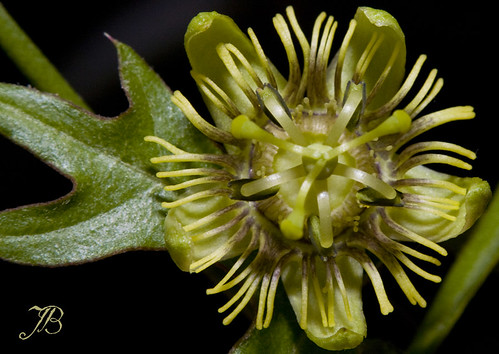
Forgive me if I seem unseemly exited right now, but I've been holding my breath for a while and am finally confident enough to exhale. Why, you ask? Because of these, fruit on my passiflora tenuiloba vines:
Passiflora tenuiloba is a native Texas passion flower. It is very tiny, and thus not available in cultivation. That's a fancy way of saying you can't buy it at nurseries. Once I got into passion flowers in a big way 7 years ago or so, I decided to try growing all the native Texas species. This is one of the first I got--and promptly killed it by over-watering. Over the years, I acquired more through trades and even going out and digging some up (with the property owner's permission, of course). Maddeningly enough, most of those died from drought or being eaten by caterpillars or other such. The few times I coaxed blooms out of them, I only had one plant, and this species isn't self-fertile. So this summer, the one remaining tenuiloba I had in the ground beneath my big century plant seemed to be growing very well, and I was fortunate enough to acquire a couple new plants of unrelated parentage. Then disaster struck, when the neighbor's yard crew removed the trellis I had protecting the in-ground plant, and promptly mowed it down. I was, to put it kindly, not happy.
Fortunately, there is a happy ending to all this. The in-ground tenuiloba bounced back with surprising vigor, and began setting flower buds. Then, much to my surprise and delight, one of the potted tenuilobas set a few buds as well. Fast forward a few weeks, and I've got flowers opening at the same time. Hand-pollinating the flowers is no easy feat--they're barely a centimeter across--and juggling the tweezers and magnifying glass is a challenge. But my patience and perseverance is being rewarded with 11 tenuiloba passion fruit! Hopefully, I'll be able to coax some more out of the plants this fall, before all is said and done. And once they're ripe, I intend to contribute the bulk of the seeds to the Passiflora Society International seed bank, to make this interesting species available hither and yon.
Now Playing: The Art of Noise The Ambient Collection
Chicken Ranch Central
Showing posts with label passiflora tenuiloba. Show all posts
Sunday, October 06, 2013
Wednesday, September 18, 2013
Tenuiloba
Back the other month, I had an unfortunate incident where the lawn men working on my neighbor's yard hacked up part of my century plant in the front yard and then proceeded to remove a small trellis and mow down a passiflora tenuiloba plant I'd had growing beneath the agave. Needless to say, I was livid, because the tenuiloba, after two years, had finally put out flower buds. I've been trying to grow this uncommon Texas native (it's not rare--it grows wild in parts of South and West Texas, but it isn't in cultivation and very difficult to find through nurseries) for years now, and bad things keep happening to my plants. I put up a new trellis to guard it, put down some organic fertilizer and made an effort to keep it watered during our ongoing drought. I was rewarded with it rebounding quite well, and wonder of wonders, flowering freely for me! The photos below are from the second bloom from the plant, taken with my Canon 7D and EF 100mm 2.8 macro lens utilizing a ring light for illumination.
The flowers are tiny, maybe half an inch/centimeter across, and easy to miss. The pretty colors blend together when just observed with the naked eye, and look like a dark brown. It's not until the flower is magnified that the maroon and yellow in the filaments become obvious. The bad news is that tenuiloba is not self-fertile. I have another clone of the species I bought earlier this summer, but it's showing no signs of flowering. I'm at a loss for collecting pollen from these flowers, as I can barely see the anthers without a magnifying glass. Harvesting and storing the pollen would be a big challenge, especially with no idea if or when the other plant will flower...
Now Playing: Dave Davies Rock Bottom: Live at the Bottom Line
Chicken Ranch Central
Friday, June 28, 2013
146/365: Tenuiloba foliage
Today I'm sharing the foliage of passiflora tenuiloba. This one's native to Texas, with a range starting in the Hill Country and extending west and south to more semi-arid regions. It doesn't have flashy flowers, being a small decaloba-type, but I find the foliage fascinating. It's informal name is "bird-winged passion flower," which is self-explanatory. I don't know of many other passiflora species with as elaborate a leaf form. One problem with this plant is that the stems are so thin that I haven't had any luck rooting cuttings from it, which frustrates me to no end, I assure you.

And here's a second view of some younger leaves. Note they start out with less pronounced lobes like other passis, but extend as the leaf grows and matures.

Camera: Canon 7D
Lens: Canon 100mm 2.8 macro
Lisa On Location Now Playing: Talking Heads True Stories
Chicken Ranch Central


Lens: Canon 100mm 2.8 macro
Lisa On Location Now Playing: Talking Heads True Stories
Chicken Ranch Central
Sunday, March 15, 2009
Passiflora tenuiloba
Passiflora tenuiloba is a small, unassuming passiflora native to south and west Texas. I'm partial to them, and have several potted at home. One's been blooming for the past week, with flowers maybe 3/4 inch across.

I've played around with macro a little using a Nikon 50mm f/1.8 AI-s I inherited from my father-in-law with a reversing ring. I like the manual focus and aperture control which gives me more flexible say over the final image, but it's not tremendously powerful as far as macros go. Straight shots of the tenuiloba flower weren't particularly impressive. Then I remembered that my brother'd given me a Vivitar 2x teleconverter a while back that he'd played around with but lost interest in. Could I use it for macro? First attempts resulted in error messages from my camera--the lens wasn't communicating with it, the camera said, and recommended I clean the contacts. The Vivitar had autofocus contacts on it, and somehow these were causing problems. Solution? I taped over them. Presto! No more error message. And wow, were the results striking--I've lost two stops on the lens, but fortunately it was a fast f/1.8 to begin with. I'm happy with the results, and hope to take the assembly out tomorrow and see what I can find.
Now Playing:

I've played around with macro a little using a Nikon 50mm f/1.8 AI-s I inherited from my father-in-law with a reversing ring. I like the manual focus and aperture control which gives me more flexible say over the final image, but it's not tremendously powerful as far as macros go. Straight shots of the tenuiloba flower weren't particularly impressive. Then I remembered that my brother'd given me a Vivitar 2x teleconverter a while back that he'd played around with but lost interest in. Could I use it for macro? First attempts resulted in error messages from my camera--the lens wasn't communicating with it, the camera said, and recommended I clean the contacts. The Vivitar had autofocus contacts on it, and somehow these were causing problems. Solution? I taped over them. Presto! No more error message. And wow, were the results striking--I've lost two stops on the lens, but fortunately it was a fast f/1.8 to begin with. I'm happy with the results, and hope to take the assembly out tomorrow and see what I can find.
Now Playing:
Subscribe to:
Posts (Atom)